-
U.S Birth Rate Plunges Below Sustainable Level
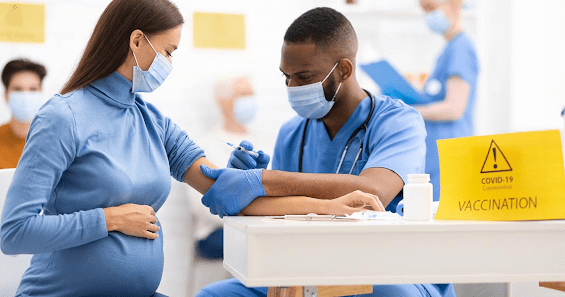
Blogger Comment: The massive increase in excess deaths and in the significant increase in new birth deaths (in or outside the Womb) in American and all western nations (China was far less significant), should have alerted the Biden Administration and all western governments to look into what is happening, but for some very strange reason this time, none of them have investigated the cause of these millions of deaths throughout all western nations.
America’s birth rate has just plunged to its lowest level in over four decades, according to the latest figures.
The U.S. birth rate is currently sitting far below the “replacement rate” which is required to keep the population at a sustainable level.
According to the data, published by the U.S. Centers for Disease Control and Prevention (CDC), fewer babies were born in America in 2023 than in any year since 1979.
The data was revealed in a new report from the U.S. National Center for Health Statistics.
There were 3.59 million babies born in 2023, down 2% from 3.66 million recorded in 2022.
This number is the lowest since 1979 when 3.4 million babies were born.
Karen Benjamin Guzzo, director of the Carolina Population Center at the University of North Carolina at Chapel Hill, told The Wall Street Journal that fewer Americans want to have children while many are delaying starting a family.
“People are making rather reasoned decisions about whether or not to have a child at all,” Guzzo said.
“More often than not, I think what they’re deciding is, ‘Yes, I’d like to have children, but not yet.’”
This number is the lowest since 1979 when 3.4 million babies were born.
Karen Benjamin Guzzo, director of the Carolina Population Center at the University of North Carolina at Chapel Hill, told The Wall Street Journal that fewer Americans want to have children while many are delaying starting a family.
“People are making rather reasoned decisions about whether or not to have a child at all,” Guzzo said.
“More often than not, I think what they’re deciding is, ‘Yes, I’d like to have children, but not yet.’”America’s declining total fertility rate peaked at 3.75 births per woman after World War II and has since collapsed to about 1.617, well below the replacement rate of 2.1.

The total fertility rate is an estimate of the number of babies a woman would have in her lifetime; 2.1 is the level needed for a generation to replace itself. A nation without children is a nation without a future.
Meanwhile, deaths are continuing to rise as births fall.
The intersection of deaths exceeding births per year appears imminent.
A nation without children is a nation without a future.
Meanwhile, deaths are continuing to rise as births fall.
The intersection of deaths exceeding births per year appears imminent.

America’s birth rates for most age groups are all declining, except for women ages 35-39 and 40-44.

Rates are per 1,000 women in specified age groups. Only the Hispanic fertility rate has rebounded.

Fertility rates are births per 1,000 women aged 15–44 in specified group The total birth rate has been well under the level of replacement since 2007.
Elon Musk has been warning the public about the threat posed to humanity by plunging birth rates around the world.
In a recent interview posted on X, Musk explains:
“There are certainly some big risks that humanity faces.
“Population collapse is a really big deal, but I wish more people would think about…the birth rate is far below what’s needed to sustain civilization at its current level.”
Earlier this month, Musk wrote in a post on X:
“Any nation with a birth rate below replacement will eventually cease to exist.”
Follow the Link for the Article… U.S Birth Rate Plunges Below Sustainable Level
And, READ MORE – WEF: Depopulation Will ‘Save Elites’ & ‘Drown the Rest’
And last but the most potent prediction that was in 2017,
“Why is the influential military arms data firm The Deagel corporation, a minor branch of US military intelligence and one of the many secretive organizations stating that in 2025 there will be a massive decline in populations of every western nation?” – note that Deagel took this web listing prediction down sometime in 2020, but the “Wayback Machine” has still got it…
https://nobulart.com/deagel-2025-forecast
The biggest in the predicted drop in 2017 within Western Nations is the UK (from a population of 65,650,000 in 2017 to a mere 14,517,860 in 2025) followed by the USA (from a population of 326,620,000 in 2017 to a mere 99,553,100 in 2025). These figures seem absolutely mad, but the nearer we get to 2025, things do appear to be accelerating in the alternative Media arena (that is censored, but you can see the other side of the story that we are not told). Therefore immigration does have a purpose therefore if and when these prediction become the truth instead of conspiracies, which basically “Deagel” is not really into as a ‘leading’ military analysist who is in the “intelligence know” working for for the US government (on paper anyway, but ultimately controlled by the Globalists)…and their “2030 Great Reset”
And,
Leaked Pfizer Docs Expose Plan to Depopulate Earth by 2025 -
Ex-CBS Reporter Blows Whistle on Executives Blocking Reporting on Hunter Biden’s Laptop
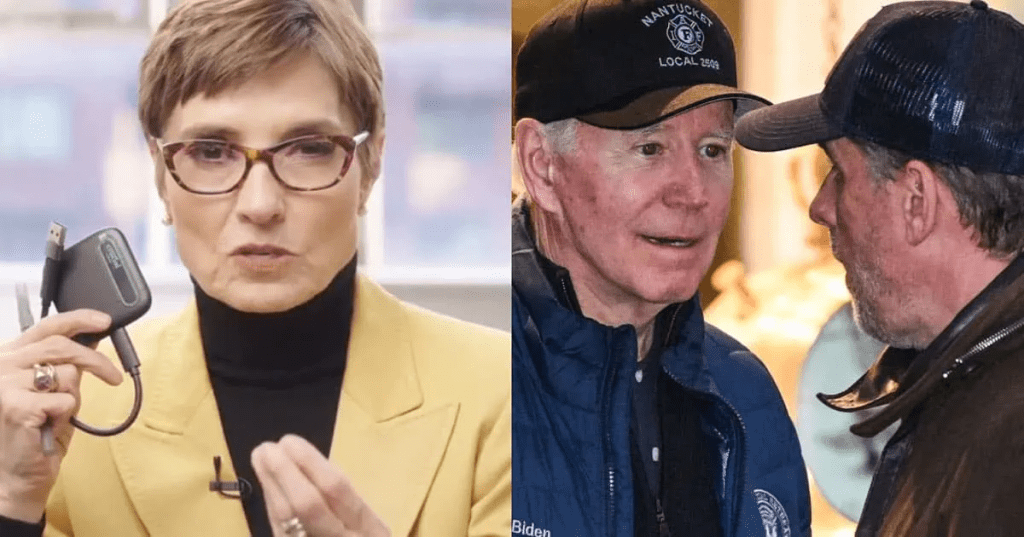
Blogger Comment: We with our ear to the ground knew that Hunter Biden was a corrupt operative where even former CBS investigative journalists are turning whistleblowers that their Excaacutive covered up for the Bidens, as Hunter had one of the best teachers in the world on the subject of corruptive practices, his father Joe the US President who studies the subject in depth for 53-years (and even before that in politics before becoming a Senator) in the corruptive school of Washington DC…no better CV really and the best university of its kind in the world…
.
Investigative journalist Catherine Herridge has blown the whistle to reveal that CBS executives actively blocked coverage of the Hunter Biden “laptop from hell” scandal, despite the story being ready to publish well before the 2022 midterms.
Herridge, a longtime national security and investigative reporter who previously served as Fox News’s chief intelligence correspondent, joined CBS in 2019 as a senior investigative correspondent.
She was fired in 2024 after probing the Hunter Biden laptop case.
The backstory of the infamous laptop dates back to April 2019.
At the time, Hunter Bide, reportedly intoxicated, arrived at the Delaware computer repair shop run by John Paul Mac Isaac with three damaged MacBook Pro laptops.
One device was destroyed beyond repair and returned to Hunter.
A second laptop required a keyboard that Mac Isaac loaned to him, a keyboard that was never returned.
The third laptop Hunter left behind for repair.
Hunter Biden never came back to retrieve it.
After repeated unsuccessful attempts to contact him, Mac Isaac lawfully took ownership of the abandoned device under his shop’s policy.
In October 2020, The New York Post published emails from the laptop.
The “October surprise” revealed evidence that Hunter Biden conducted foreign business dealings and acted as a financial conduit for Joe Biden as part of an international influence-peddling operation.
Herridge says CBS executives delayed reporting the story, despite the fact that her investigation was complete ahead of the midterms.
“When we did the story, we did it after the [2022] midterms,” Herridge said.
“I argued against that because it was ready before the midterms, and my training is that you should always do the story when it’s ready to go.
“You should not be dictated by the political cycle.”
According to Herridge, CBS finally aired the laptop story two years after the scandal was already public.
However, executives still moved to shut down further coverage, including a separate story involving Joe Biden.
Herridge says executives and producers even overrode CBS CEO George Cheeks when it came to blocking follow-up reporting.
WATCH: click on the link to view the video below… Ex-CBS Reporter Blows Whistle on Executives Blocking Reporting on Hunter Biden’s Laptop
The revelations add to mounting concerns about corporate media gatekeeping.
It also further exposes the role major broadcast networks played in suppressing a story that critics argue carried major political consequences.
Follow the link for the source… https://slaynews.com/news/ex-cbs-reporter-blows-whistle-executives-blocked-reporting-hunter-bidens-laptop/
And,
READ MORE – Whistleblower Exposes Massive Somali Fraud Scam in Ohio
-
Putin Accuses Ukraine of Attacking His Home
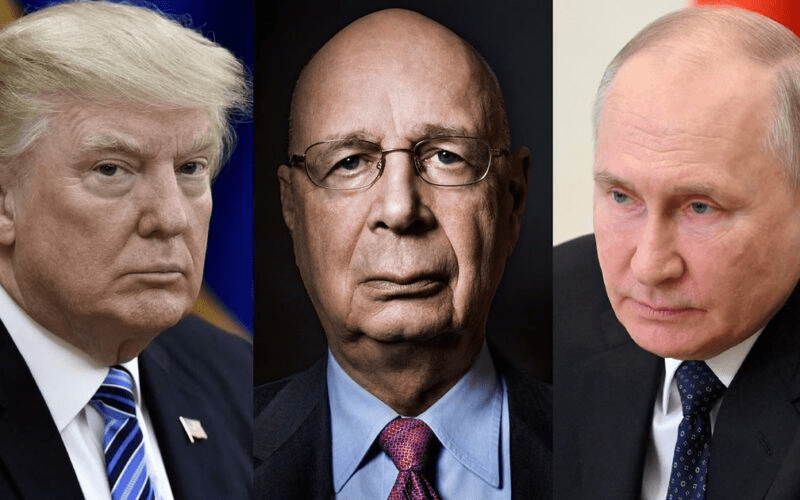
Blogger Comment: Zelensky is one of the world’s greatest con men and where he is a Globalist stooge ‘First-Class’ put there on the world stage by these Davos people who made Ukraine the first WEF controlled nation implicitly prior to the Covid-19 pandemic where few people seem to know…but where Trump and Putin has something very much in common with each other being bossom cousins in beiung WEF threats to their global plans for humanity, so better together than apart for the future of humankind as they say, but I would say mainly on the latter person if the Globalists ever tell the truth even when they are lying which they do continually…
WEF Views Trump & Putin as Major ‘Threat’ to Globalist Agenda, Davos Insider Reveals – https://world-freedom.co.uk/2025/03/05/wef-views-trump-putin-as-major-threat-to-globalist-agenda-davos-insider-reveals/
.
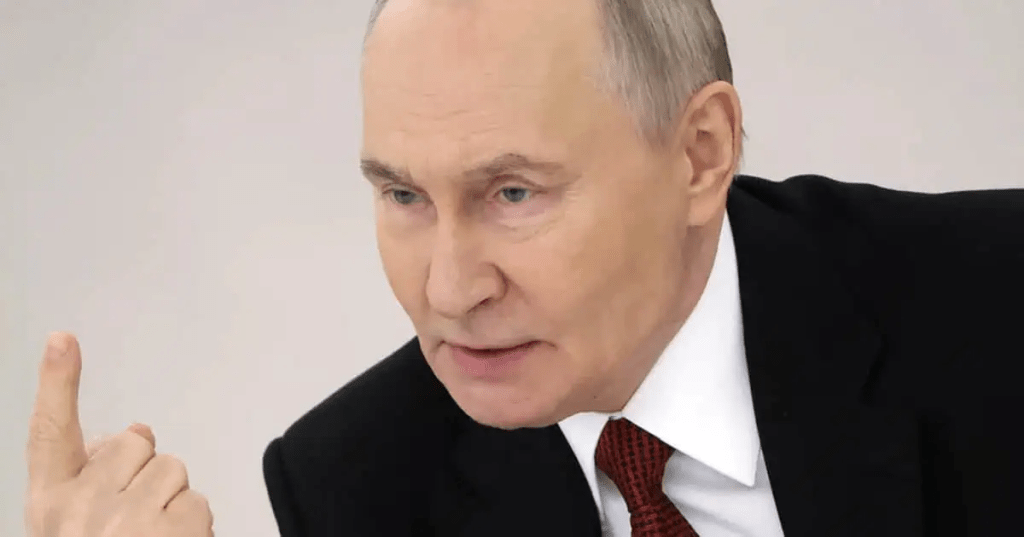
Russian President Vladimir Putin has accused Ukraine of attacking his official residence in Russia during targeted strikes.
Putin told President Donald Trump during a phone call on Monday that Ukraine allegedly attempted a drone strike on one of his official residences.
The call was the two leaders’ second conversation in as many days.
However, the claim was immediately denied by Ukrainian officials as false and politically motivated.
According to a Kremlin readout, Putin said Moscow would “adjust” its negotiating posture in response to the reported incident.
The statement signals that Russia may be preparing to take a harder line in ongoing discussions over a potential U.S.- and Ukraine-backed peace framework that has been under quiet negotiation for weeks.
Russian Foreign Minister Sergei Lavrov claimed Russian air defenses intercepted 91 long-range drones.
The drone was allegedly headed toward the Dolgiye Borody presidential residence in Russia’s Novgorod region.
The property is located between Moscow and St. Petersburg.
Ukrainian President Volodymyr Zelensky rejected the allegation outright, however.
Zelensky is accusing Moscow of manufacturing a false flag narrative to justify further strikes.
In a post on X, Zelensky wrote:
“This alleged ‘residence strike’ story is a complete fabrication intended to justify additional attacks against Ukraine, including Kyiv, as well as Russia’s own refusal to take necessary steps to end the war.
“Typical Russian lies.
“Furthermore, the Russians have already targeted Kyiv in the past, including the Cabinet of Ministers building.”
“Ukraine does not take steps that can undermine diplomacy,” he continued.
“To the contrary, Russia always takes such steps.
“This is one of many differences between us.”
Reuters reported that Lavrov warned Moscow would retaliate over what he described as an attempted strike on Putin’s home in northern Russia.
The exchange comes as Trump and Putin are expected to meet in Alaska for direct discussions.
The engagement is seen as central to Washington’s effort to secure negotiated de-escalation after months of stalled diplomatic movement.
The competing claims highlight the deep distrust now shaping the conflict, even as U.S. officials continue to push for a diplomatic resolution.
Instead of signaling openness to compromise, Moscow’s statements suggest it may be preparing to move in the opposite direction by using the alleged incident to justify a tougher negotiating stance and potential escalation.
Follow the link for the source… https://slaynews.com/news/putin-accuses-ukraine-attacking-home/
And,
READ MORE – New York Times: Zelensky ‘Systematically Sabotaged’ Ukraine Anti-Corruption Efforts
-
Disney Agrees to Pay $10 Million Settlement for Violating Children’s Privacy Laws

Blogger Comment: The Globalist reach knows no bounds and their Democrat darlings and puppets just take orders from their masters in Davos…never take Disney on face value anymore, as they defioniytely are not worth your trust when you realise what they are into…
.
The U.S. Department of Justice has announced that a federal court has approved a stipulated order resolving allegations that Disney Worldwide Services Inc. and Disney Entertainment Operations LLC violated federal children’s online privacy laws.
According to the Justice Department press release, the government alleged that Disney violated the Children’s Online Privacy Protection Act (COPPA) and its implementing regulations.
COPPA prohibits operators of websites or online services from knowingly collecting, using, or disclosing personal information from children under 13 without notifying parents and obtaining verifiable parental consent.
The complaint, filed in the U.S. District Court for the Central District of California, alleged that Disney failed to properly designate certain YouTube video content as being directed toward children.
This failure allegedly resulted in advertisements being targeted to child viewers on the platform.
As a result of that failure, Disney and third parties acting on its behalf collected personal information from children without the required parental notice or consent, in what the government said was a direct violation of COPPA.
The Justice Department release also emphasized the scale of Disney’s YouTube presence, noting that its content has accumulated billions of views in the United States.
Officials argued that the scope of that audience heightened the potential privacy impact because the content in question includes videos appealing to children, such as programming featuring Disney characters, animation, and family-oriented entertainment.
The case represents a COPPA enforcement action administered by the Federal Trade Commission (FTC).
The FTC has pursued similar actions against other companies over improper data collection involving minors on digital platforms.
Under the stipulated order approved by the court, Disney agreed to pay a $10 million civil penalty to the United States.
The agreement resolves the allegations without an admission of liability by the company.
The order also imposes injunctive relief intended to prevent future violations, prohibiting Disney from operating on YouTube in any manner that contravenes COPPA requirements.
In addition, Disney must implement a comprehensive compliance program to ensure continued adherence to the law, including internal policies, employee training, audits, and procedures for properly identifying and labeling child-directed content.
In a statement, Assistant Attorney General Brett A. Shumate of the Justice Department’s Civil Division said:
“The Justice Department is firmly devoted to ensuring parents have a say in how their children’s information is collected and used.
“The Department will take swift action to root out any unlawful infringement on parents’ rights to protect their children’s privacy.”
The settlement resolves the case without trial and does not include findings of fact beyond the allegations contained in the complaint.
Disney did not issue a public statement quoted in the DOJ press release regarding the settlement or the allegations.
Follow the link for the source… https://slaynews.com/news/disney-pay-10-million-settlement-violating-childrens-privacy-laws/
And,
READ MORE – USDA Rolls Out Major Shift for U.S Meat and Egg Labels
-
San Francisco Mayor Secretly Signs Bill That Could Give Black Residents $5 Million Each

Blogger Comment: The Democrat’s destruction of the USA continues unabated and where these people will never stop bringing the USA and its people to their knees for their Globalist masters…how long will it take the American people to realise this and where Trump is not the one either, so how long will it also take the American people to realise that as well…as the only way to get back the American dream now is a new political system that supplants the two incumbent political parties with a new grass-roots political system that works for the people and not the Globalists, where that is a continual recipe for destroying western civilization now and what is the Davos Globalist’s agenda, as they have said so many times over the last 55-years…period…
.
San Francisco’s Democrat Mayor Daniel Lurie quietly approved legislation just days before Christmas, creating a city-sanctioned reparations fund that lays the groundwork for potential future payments that could reach $5 million per eligible black resident.
Lurie signed the Reparations Bill two days before the holiday with little public attention, authorizing the establishment of a reparations fund but without allocating any city money to it.
The ordinance formalizes the fund recommended in the African American Reparations Advisory Committee’s 2023 report.
While the measure does not dedicate financial resources, it creates a framework that could later be funded either through public dollars or private donors.
The advisory committee is tasked with developing “recommendations for repairing harm in our black communities,” according to its website.
San Francisco journalist Erica Sandberg was among the first to highlight Lurie’s low-profile approval of the ordinance.
The committee’s 2023 report proposes what it describes as a $5 million lump-sum payment for each eligible African American adult in order to “compensate the affected population for the decades of harm that they have experienced.”
Roughly 50,000 black residents live in the city, though eligibility standards have not been clearly defined.
That proposal has generated significant backlash.
It is one of more than 100 recommendations in the report, which also include debt relief, debt forgiveness, city-funded housing, and a guaranteed $97,000 annual income for black residents.
In 2023, the Hoover Institution warned that implementing the reparations package would amount to an estimated $600,000 tax burden per non-African American household in San Francisco.
Lurie disputed the feasibility of that outcome, telling the Daily Mail that the city’s fiscal reality makes such spending unrealistic.
“For several years, communities across the city have been working with the government to acknowledge the decades of harm done to San Francisco’s black community,” Lurie wrote.
“While that process largely predates my administration, I am signing the legislation to create this fund in recognition of the work of so many San Franciscans and the unanimous support of the Board of Supervisors.”
Lurie noted that San Francisco is facing a $1 billion budget deficit next year.
“That means identifying key priorities for funding so we can continue delivering those services well,” he explained.
“Given these historic fiscal challenges, the city does not have resources to allocate to this fund.”
He added that the administration remains open to outside financing, stating that “if there is private funding that can be legally dedicated to this fund, we stand ready to ensure that funding gets to those who are eligible for it.”
Critics have questioned the timing and quiet approval of the measure, arguing that city officials advanced a highly controversial policy during the holiday period when many residents were unlikely to notice.
Follow the link for the source… https://slaynews.com/news/san-francisco-mayor-secretly-signs-bill-black-residents-5-million-each/
And,
READ MORE – LA Mayor Karen Bass Admits Mishandling Devastating Wildfires
-
HUD Report Exposes Billions in Suspicious Rental Aid Under Biden, Including Payments to Dead People
Blogger Comment: This shows just a little bit of the corruption of Biden and the Democrat Party when in office and even at US$50,000, 000,000 (US$50 billion) just a drop in the ocean of the Democrat Administration corruptive ways in the USA… but where I am now seriously questioning the integrity of Trump and his too close a realationship with the Globalists who he said he was not one of them leading up to the presidential elections in 2016 and reinforced that in the 2020 political retrial for President…but Trump has now let down too many people who believed in his words and what Globalists in Davos do continually, as they have no respect whatsoever for humanity and we know that as they have said so many times…and needs reducing to below 500 million humans…
.
An explosive new report from the U.S. Department of Housing and Urban Development has exposed a jaw-dropping misuse of taxpayer money that could make even the most hardened fiscal hawk wince.
The HUD report has exposed that billions in federal rental assistance, distributed during the previous administration, ended up in the hands of questionable recipients, including tens of thousands of deceased individuals and potential non-citizens.
This stunning revelation comes straight from HUD’s fiscal year 2025 Agency Financial Report, a document obtained by the New York Post that paints a troubling picture of oversight gone awry.
During fiscal year 2024, HUD shelled out roughly $50 billion in rental assistance to non-federal entities across the country.
Of that staggering sum, a whopping $5.8 billion was flagged as questionable payments, raising serious concerns about accountability.
The funds disproportionately flowed to areas like New York, California, and Washington, D.C., though payments to deceased recipients were identified in every single state.
Through an automated comparison of its records with a U.S. Treasury database, HUD uncovered that 30,054 deceased tenants were either enrolled in or received rental assistance posthumously.
Additionally, thousands of potential non-citizens also benefited from these funds, highlighting a systemic failure to verify eligibility.
One can’t help but wonder how such a colossal lapse happened under the watch of an administration that promised competence and transparency.
HUD’s internal financial review and analytics brought these issues to light, but the report points a finger at the prior administration for pushing rapid fund disbursement with scant oversight.
According to the findings, the Biden team failed to equip HUD with the necessary tools to ensure compliance with rental assistance guidelines, leaving the program vulnerable to abuse.
In a statement to the New York Post, HUD Secretary Scott Turner said:
“A massive abuse of taxpayer dollars not only occurred under President Biden’s watch, but was effectively incentivized by his administration’s failure to implement strong financial controls, resulting in billions worth of potential improper payments.
“HUD will continue investigating the shocking results and will take appropriate action to hold bad actors accountable,” Turner added, signaling a return to the tougher integrity measures seen in earlier years.
Before any drastic steps are taken, HUD must confirm the extent of potential fraud to decide whether to halt funding or pursue criminal referrals.
With new procedures in the works to pause or revoke payments to problematic recipients, there’s hope that taxpayer dollars will finally serve the vulnerable communities they’re meant for, not phantom tenants or ineligible parties.
Follow the link for the source… https://slaynews.com/news/hud-report-exposes-billions-suspicious-rental-aid-under-biden-including-payments-dead-people/
Abd,
-
EU Leaders Move to End Social Media Anonymity

Blogger Comment: If you wish to look into the face of evil and want to see the face of evil, you only have to just look at the image above as the Globalist’s puppets are all that, with none of them having any good intensions for their fellow men and women that make up humanity…just for themselves alone and if that means controling them to eventually culling them…then so be it in their insane minds…for all the technologies that the people’s taxation has provided (WWW, social media platforms, lethal virus injections, Digital ID, CBDC digital control money, carcinogen food additives, Chemtrails, 5G when they switch it on for its real purpose not pure communications if you step outside the Narrative… et al) for over the last 80-years has had one purpose and intention, to control humanity and to depopulate the world to down to less than 500 million humans, for we know this as the Davos Globalists have said so many times since 1971 out of their own mouths if you care to do your own investigation using alternative news media platforms and not the Globalist’s controlled MSM of the World Economic Forum (the WEF) and their insane agenda for humankind, as their news is totally suppressed news that you never hear about…for if you do not know this, you will be ignorant until the unimaginable does happens by 2030 through their genocidal “Great Reset” agenda for humanity, where we shall all become controlled and totally suppressed servants (who are left) to the Globalists and their wishes, without fail, as they now control all western nations except four, the USA, Hungary, Slovakia and Italy presently…we have to change thia sand break out of this grip, as currently they have all the EU and UK military power behind them through their puppet political leaders that they have literally “enthroned” within our western governments over the past quarter of a century…
.
Ireland’s incoming leadership role in the European Union is being positioned to advance a sweeping new digital control agenda to end online anonymity and roll out verified identity requirements across social media platforms.
Irish Tánaiste Simon Harris confirmed that Ireland’s government intends to use its EU presidency to push for bloc-wide rules forcing users to confirm who they are before posting or interacting online.
However, critics warn that the would fundamentally transform the internet into a monitored identity-tracking grid.
Speaking to the Irish outlet Extra.ie, Harris framed the proposal as an effort to defend what he called “democracy” from online anonymity and what he described as digital manipulation.
The push will advance in parallel with an upcoming policy from Media Minister Patrick O’Donovan aimed at preventing children from accessing social media.
It’s a plan modeled on Australia’s restrictions and expected to roll out during Ireland’s EU term next year.
To implement the measures, governments would need to rewrite sections of the EU’s already-controversial Digital Services Act, shifting it from platform regulation into a gateway for government-linked identity enforcement across the internet.
Privacy and free speech advocates warn that such a framework would open the door to unprecedented monitoring, blacklisting, and political enforcement against citizens who step outside approved narratives.
Harris insisted the initiative is not driven by personal grievance, but by what he described as concern for public life.
He also signaled confidence that Ireland will not be acting alone.
Pointing to growing alignment among Western leaders, Harris said:
“If you look at the comments of Emmanuel Macron…of Keir Starmer…recently, in terms of being open to considering what Australia have done…
“You know this is a global conversation Ireland will and should be a part of.”
Harris is suggesting a coordinated international movement toward identity-verified speech.
Ireland is home to many of the world’s largest technology firms.
Those companies are already under heavy EU scrutiny, and further regulation is expected to face resistance.
The United States has also increasingly pushed back against European online speech controls, even imposing visa bans on EU officials involved in such regulatory regimes.
Despite that mounting tension, Harris signaled the government plans to move forward while avoiding open confrontation, saying:
“This is a conversation we want to have now.
“We don’t want to have it in an adversarial way.
“Companies require certainty too, right?”
Harris also backed O’Donovan’s age-verification initiative, arguing that restrictions already exist in law but are not enforced.
“We have a digital age of consent in Ireland, which is 16, but it’s simply not being enforced,” he said.
From a civil liberties standpoint, critics warn that eliminating online anonymity would mark one of the most consequential shifts in Western digital policy in modern history.
Anonymous speech has long protected whistleblowers, dissidents, political critics, and citizens speaking under social, cultural, or institutional pressure.
Once identity-tracking systems are embedded into digital infrastructure, they are rarely rolled back and can easily be expanded into speech-scoring, access controls, or political surveillance.
Even Harris appeared to signal that tech platforms could be pushed to implement such measures voluntarily, without legislation, stating:
“These companies are technology companies.
“They have the ability to do more, without the need for laws.”
Harris is suggesting that platforms could deploy internal mechanisms to manage bots, algorithms, and age verification.
Opponents argue that such “voluntary compliance” would in practice amount to government-directed censorship conducted through private platforms, beyond the reach of democratic accountability.
As Ireland prepares to assume its EU leadership role, the country now stands at the center of a rapidly escalating global debate over whether the future of the internet will remain free, open, and anonymous or be transformed into a tightly controlled system where every word is tied to a verified identity and monitored from above.
Follow the link for the source… https://slaynews.com/news/eu-leaders-move-end-social-media-anonymity/
And,
-
“THE INNOVATION CHAIN” and Why the ‘Innovation Chain’ is so Important for the Future World and Why things have to Change for Humanity – But more importantly, it is the people that have the most creativity and not universities, government or advanced research centre wherever they may be surprisingly”


Nobel Laureate Dr. Glenn Seaborg (Element 106 Seaborgium), scientific adviser to ten US Presidents and1st President of the World Innovation Foundation

Nobel Laureate Dr. Jerome Karle, 2nd President of the World Innovation Foundation and former Chief Scientist of the US Navy
Professor John Argyris FRS (Royal Medal) FREng (Prince Philip Medal), Modern Inventor of the Finite Element Method and the 1st Chairman of the World Innovation Foundation

Definition of Innovation
‘the creative force of humankind that allows the progress of the world to advance’
World Innovation Foundation, 2006 ©
This is a Blog that the Davos Globalists banned through their control of Google Blogger because it did not resonate with their Globalists Narrative of the Future Doom and Destruction of Humanity (and published ‘initially’ on February 14, 2014) and then destroyed the Swiss World Innovation Foundation (The WIF) Charity based in Bern…
The people of the United Kingdom are the most creative and innovative people in the world. Don’t take my word for it, but the Japanese and the Germans. For in the 1980s the Japanese and in the 1990s undertook extensive global research into which country and people were the most inventive and creative in the world. The Japanese MITI determined that at the fundamental level the thinking of the people of the UK that had created the modern world and their technologies equated to 54% of all the world’s thinking. The Germans came up with a figure of 53%. But then determined also that at least 75% of this world-changing creative thinking had not emanated from our universities or corporate advanced centres of research, but in the minds of normal people outside these advanced confines of research excellence. Therefore the United Kingdom is sat on an absolute gold-mine of creativity and innovation, but our political leaders do not understand where the thinking that produces dynamic economies comes from. They do not know that it is basically, the man or woman in the streets. For if they did, they would develop the creative infrastructure in the UK to release this pre-eminent quality that resides here. But they do not. Consequently now that the United Kingdom is out of the EU, they should if they wish to have the world’s most dynamic country per capita in 20-years time. Therefore it is not our universities that our Politicians should be investing in predominantly, but their own people, as that is where the real secrets of economic dynamism resides.
Unfortunately the NESTA was created for this purpose and at the time we thought that this was the best thing since sliced bread, but it did not turn out to be that way. We know as we advised on its creation. What happened was a con, as the initial priming sum of £200 million lottery money was already allocated on pet projects that the government had devised and therefore all those UK inventors that applied for funding, had no chance of getting a single penny…as it had already gone. Now the NESTA has had over £1,500,000,000 in funding through it with very little payback. The reason, pet project abound and very few real British inventors ever get a look in. Therefore this is a political road to nowhere in reality and another gravy train to put it bluntly. Indeed have you ever heard of a single invention that has come out of the NESTA that has been the basis of say a £50 million turnover a year new company, for I have not. If you have please post to this blog.
Why do countries not excel in economics even though billions are ploughed into creating new wealth by governments and corporations every year? Indeed why is it that the UK for instances after investing over £10 billion every year in research and development (mainly to our universities) by government never serves its people as it should and things never really materialise for the better and increases the people’s living standards. For year-on-year things just get economically worse for 90% of the people and where according to PwC’s chief UK economist John Hawksworth, the UK’s total debt will be between £10.2 trillion and £11.5 trillion (everything – government, financial, private and corporate debt) by 2015 and only next year.
The problem is two-fold.
Firstly the funds are directed towards the wrong people who are second in line in the innovation chain.
Secondly governments and corporations are corrupt in that certain powerful individuals within go out of their ways to make sure that funds are channelled towards initiatives and R&D that indirectly lines their own pockets. Some are called ‘pet’ projects as well but where these powerful individuals are also on a kudos trip to nowhere for the people and shareholders alike, but of course at everyone else’s immense expense.
These two fundamental failings for people, their taxation and investments (shareholders) happen in every nation throughout the world. Vested-interests and personal gain of the influential few behind the scenes stifle the majority of real innovation and creativity and where it is not in their personal interests to allow the really good things to materialize. Indeed government advisers and even deputy prime ministers in some countries (usually unknown to their Presidents) undertake covert operations in diverting funds indirectly for their own personal gain by putting blocks on projects and schemes that would make a great difference for the people of a nation who have elected them. They are users and manipulators of the system and for their own ends, but where their leaders are not aware of what they are doing.
The second scourge on the people is directly linked to the first of the two-fold problem and why very little in real innovation never materialises, compared to what innovation there is out there across the globe. This is because the fundamental thinkers are not allowed to even enter the arena in the first place. For the history of the world has shown that at the fundamental thinking level the majority of people whose ideas, inventions and creative thinking did not come from our universities or advanced corporate R&D centres but from the minds of the masses, who were outside these elitist systems. Indeed the ‘innovation chain’ consists of (or it should but it does not),

The fundamental thinkers who first came up with the idea, invention or innovation no matter if this were in education, science & technology, business, management or social change at the global level.
Our universities and corporate R&D centres that can then exploit the fundamental and revolutionary thinking of the real thinkers that change the world. Unfortunately universities and corporate R&D centres are not the beehives that many think who come up with the ideas, invention and innovations on a global scale and are according to history very poor incubators for the emergence of new fundamental thought. Universities and corporate R&D centres should therefore be our second level in the innovation chain and not the first (that is where all governments and corporates fail and fall at the first hurdle). Hopefully that once governments and shareholders eventually understand this great deficiency in the creation of economic wealth they may see their nations excel in the future but not before. Indeed if they continue to stay with the status quo they will simply keep shelling-out more and more billions every year that basically is like throwing money down the road and where according to statistics only a mere 5% is ever repaid out of the 100% invested in current systems on non-innovative R&D expenditure. What an absolute waste!
Corporate leading-edge and advanced technological manufacturing facilities that has decision-makers who see potential when it is looking them in the face and invests in what (1) and (2) of the innovation chain has created for economic and financial exploitation. Corporates are not good at detecting this and that is why we have to go for a fully connected innovation chain and not the decoupled system that we have used as an ad hoc system for decades now. The system that is now failing the West in particularly very badly as real standards of living go down by the year for the people as others take the high ground in economic power.
But things I am afraid will not change for a nation or its people until corruption is rooted out and even deputy prime ministers in some countries are despatched to the dustbin of corrupt has-beens. This is a serious situation, but where most people living in countries around the world are not conscious of these fundamental reasons why things never go right or change. It is because billions are corruptly diverted year-in, year-out by the internal working of the establishment in both government and our corporate giants. Unfortunately this is the case throughout the world and the West is no different here.
So no, not until the innovation chain is completed and the fundamental thinkers outside our university systems and corporate R&D centres are allowed to kick-start the whole innovation and exploitation process, will nations and their people excel for a better life (for themselves but particularly for their young). For until that happens everything is a mirage and smoke& mirrors in reality. I believe the financial meltdown and the ‘real’ debt of western nations shows this clearly and where we basically live from day to day in the West and the benevolence, if I can put it that way, of our global creditors.
Below this article there is a non-exhaustive list of people and their backgrounds that made the modern world what it is today. In the vast majority of cases they came from poor backgrounds, with little education and many were self-developers through their creative minds. These are people that the ‘Establishment’ do not recognise due to the elitist and corrupt systems that abound within governments and big business. And the reason why again that these vastly wealthy individuals and powerful institutions are above even the law itself, whether you live in the West or the East.
But there is a fear in both government and big business that if they allowed a system to evolve where the people were seen to be the real driving force through innovation there would be a revolution and they themselves would be out of business. That is why really the present system is a charade and smoke and mirrors in reality. For the supposed leaders are not the ones with the creative minds but where the real progress of humanity lies in the people and nowhere else. Therefore the great need for the people to be involved with the economic development of a nation at the fundamental level for they are the ones with the answers. That is why also I have said many times that the ‘elitist’ system and the non-innovative ‘establishment’ that controls all of us will eventually be the death of us all.
In 1997 and 1998 when the Blair government came into power over 40 of the world’s leading minds including 8 Nobel science prize winners advised the new government to invest heavily in the development of the high technology products and services of tomorrow to create a future dynamic economy. The thinking of these great scientists and engineers had been the basis of global technologies that drove jointly companies turning over in excess of $1 trillion a year and had created multi-new industries that did not exist 40 years ago. But the Blair government and Whitehall took no notice and where one Nobel Laureate stated that he had wasted around 2-years of his life trying to help the UK and its people. For the new government put all its eggs in the one basket of service industries including ‘SUBSTANTIALLY’ the ‘CITY and Financial risk monopoly trading’ (where we all know now where that took us all with debt and losses in 2007) . We all know now where that took us and where in 2008 90% of the world’s people were impoverished on a relative scale to the 1930s. Indeed as the chief economist of PwC predicted, the UK has now a total country and people debt of around £11.5,000,000,000,000 (£11.5 TRILLION). Therefore this strategy could still be activated and updated now, but the where the big question is, have we new political leaders coming in after Cameron with the intuition that this is where our dynamic future economy lies and will come from? It is very much doubtful, but where it is hoped that post BREXIT that they do for the people’s sake and that of our future generations. as without a change in mind-sets, things will either stay as they are or decline. We have to hope that the next breed of political leaders post BREXIT see the light and forge an economy based upon what some of the world’s most creative minds tell us to do, as they have created the basis of new global industries and something that few others have achieved. Indeed, with the unique strength and prowess of the British people’s creative minds according to the Japanese and the Germans if this was unleashed, Britain would certainly lead the world. I have no doubt there.
One person that stands out above most polymaths was George Boole that most people have never heard of, but he invented the thing that made the ‘digital’ world possible, as he was the inventor of the ‘1’s and ‘0’s that drive the whole digital age from computers to the internet to and to the possibilities of AI with his Boolean Algebra. He was a a totally self-educated mathematician of the highest order who had NO university or college degree, but totally independent of formal education, invented the means and basis for the creation of the digital age for without his work, the digital age simply would NOT exist. Indeed with no degree he was made FRS (first person ever) and professor of mathematics at Cork University, Ireland…with no degree or diploma…one of the people that created the modern world, not advanced universities of research or advanced institutions of corporate research, but single individuals totally outside these so-called elevated centres of advance knowledge and learning.
I hope readers enjoy reading about in brief the real people who have changed the world and where they came from – definitely not our universities or corporate R&D centre that should be secondary as I have said to the fundamental thinkers that really make things happen and change the world.
Dr David Hill
Chief Executive
World Innovation Foundation
14 February 2014 (minority updated 26 August 2023)
Non-Exhaustive List of Inventions that have Changed the World and made the Modern World what it is Today
INVENTION INVENTOR NATION BACKGROUND NOTES Jet Engine Frank Whittle U.K. His father was a mechanic. Came from a working-class background. Became an RAF Officer through merit. The Establishment would not take notice of his revolutionary thinking. It took him 10-years to convince them. Created a new global industry. First Adhesive Glue Not known U.K. A Patent was issued around 1750 Although it is known that it existed, no record is available Air Brake George Westinghous-e U.S.A. His father had small shops manufacturing agricultural machinery. Working-class entrepreneurial background. Self-educated inventor who created one of the USA’s greatest electric manufacturing companies.. Electric Transformer George Westinghous-e U.S.A. He was very inquisitive as a boy in anything electrical. First large system supplying electricity from one circuit for multiple end-uses George Westinghous-e U.S.A. Milking Machine Anna Baldwin U.S.A. She was a small working farmer Created a new global product. Automotive air bags Allen K. Breed U.S.A. He had a working-class entrepreneurial background. Built from the grass-roots level an international company. Created a new global product Electro-mechanical crash Sensor (EMS). Allen K. Breed Modern Air Conditioning Willis Haviland Carrier U.S.A. He had a working-class entrepreneurial background. Started his working life on a salary of only US$10.00 per week.Created a new global industry. Aeroplane/Aviation Orville & Wilbur Wright U.S.A. They were owners of small bicycle business They were both self-trained mechanics. Created a whole new global industry Tin Can Peter Durand U.K. He was a middle-class merchant selling commodities. Revolutionised food preservation and its transportation over an indefinite time. It was the birth of the modern packaging industry Portland Cement Joseph Aspdin U.K. He was the eldest son of a bricklayer and a bricklayer himself. He called the cement Portland cement because it resembled Portland stone. Created the basis of a new global industry. Reinforced concrete Joseph Monier FRANCE He was a gardener who made garden pots and tubs of concrete reinforced with an iron mesh. Besides his pots and tubs, he promoted reinforced concrete for use in railway ties, pipes, floors, arches, and bridges. Created the basis of a new global industry. Cates Eyes Percy Shaw U.K. He was a young road repairer from a working class family. Greatly advanced road safety at night throughout the world. Created a new global product that has saved thousands of lives over the years. Thermos Flask James Dewar U.K. He was the son of an innkeeper The majority of households in the developed world have bought one of these several times over. Created a new global product. Solidification of liquid Hydrogen James Dewar Scotland He was the youngest of six boys and was born and raised in Scotland. By the time he was fifteen he had lost both parents, and went to live with his brother. He went to Edinburgh University and after graduation stayed on to work as a tutorial assistant. Allows bulk storage of a needed commodity and where its importance will significantly increase in the 21st century and beyond. Basis of a new global industry. Electric Motor Michael Faraday U.K. He came from a poor family and was the son of a blacksmith. He started in life as an errand boy for a London bookbinder. The modern world could not function in many ways without the device. Faraday through his work created a whole new technological industry. Electromagnetic Induction Michael Faraday U.K. His discoveries are the basis of all modern electromagnetic technology. Therefore Faraday is the ‘father’ of the electricity industry. Generator Michael Faraday U.K. Allows continuous source of electricity. Created the basis of a new global industry. Transformer Michael Faraday U.K. Allows the electric power to be increased and decreased at will. Created the basis of a new global industry. Dynamo Michael Faraday U.K. Producing electricity at will. The modern world could not do without it. Created the basis of a new global industry and possibly the greatest invention of all time as all other inventions such as the WWW, could not exist without Faraday’s invention . Electromagnet William Sturgeon U.K. He was the son of a shoemaker, apprenticed into shoemaking and thereafter an electrician by trade. The beginning of using electrical energy for making useful and controllable machines and which laid the foundations for large-scale electronic communications. I.e. telephone etc. Created the basis of a new global industry. Gas Mask/Breathing Mask John and Charles Deane U.K. They were blacksmiths by trade. Basis of a new industry and underwater diving and Scuba diving. Holography Dennis Gabor Hungary His father was a mining engineer.With the rise of Hitler in 1933 he left Germany and after a short period in Hungary went to depression stricken England and where finding a job as a foreigner was very difficult. Through perseverance and over many years of hardship he eventually invented holography and thereby a 21st century industry. Basis of a new global industry. Internal Combustion Engine Samuel Brown U.K. He was an engineer from a working class background. He adapted an old Newcomen steam engine to create the first engine to drive a road vehicle. Pre-runner to the modern automobile. Laws of conservation and dissipation of energy William Thomson, Lord Kelvin U.K. His father was the son of a farmer and he was more-or-less self-taught. Father of modern thermodynamics and created the basis of a multi-global industries. Locomotive Richard Trevithick U.K. His father was a mining manager with only a reasonable income. Therefore he had to work for everything that he made in life and had no financial help other than his own personal earnings. He is regarded as the ‘Father of railway engines’. Created the basis of a new global industry. Light Bulb Humphry Davy U.K. His father was a woodcarver by trade with little financial income. Invented the first electric light. Davy connected two wires to a battery and attached a charcoal strip between the other ends of the wires. The charged carbon glowed making the first arc lamp. Created the basis of a new global industry. Penicillin Alexander Fleming Scotland His father was a farmer living in a desolate area of Scotland and where Fleming had no contact initially with science. His work created an industrial base for possibly the greatest selling medical cure in history. Created the basis of a new global industry. Polyester John Rex Whinfield and James Tennant Dickson U.K. They were employees of a small regional company. Basis of a new global product. Periodic Table John Newlands U.K. His father was a minister of the church and educated him at home. He did not have any formal state school education. He worked initially for a time at an agricultural college. Had the idea of arranging chemical elements in order of their relative atomic masses and he arranged his elements in columns. The Basic building blocks of the Universe and possibly the most important listings of all time. Radar Robert Alexander Watson-Watt U.K. His father was a carpenter by trade and where he learnt Watson-Watt to use his hands and make things. Invention that revolutionised the aviation industry. Created the basis of multi-global industries. Rubber Bands Stephen Perry U.K. He was a working-class Entrepreneur. A product used worldwide in business and home. Created the basis of a new global product. Radio Waves James Clerk Maxwell U.K. His father was a lawyer with no scientific background but where James Clerk Maxwell developed an early interest in scientific investigation. Predicted the existence and from this connection sprang the idea that light was an electric phenomenon. Established the clue for the invention of the Radio. Seismometer James Forbes U.K. He was a self-taught instrument maker. Instrument determining the magnitude of earthquakes. Sewing Machine Thomas Saint U.K. He was a joiner & cabinet maker Created a new industrial machine that became the basis of a global industry. Steel Production – The Bessemer Process Henry Bessemer U.K. His father was a typefounder. Bessemer was an inventor working under his own initiative and intuition.He said of the reasons why he had made the breakthrough,“I had an immense advantage over many others dealing with the problem inasmuch as I had no fixed ideas derived from long-
established practice to control and bias my mind, and did not suffer from the general belief that whatever is, is right.”Created the means by which mass-production of steel could be done inexpensively. This was the basis of a whole new global industry, created the material which built the 20th century and what made Andrew Carnegie the world’s richest person. Created the basis of a new global industry. Submarine William Borne U.K. He was a former Royal Navy Gunner with no qualifications or background in ship design whatsoever. It never got off the drawing board because no one would finance it. The three machines that Revolutionised the Textile Industry1. Spinning Jenny2. Spinning Frame3. Spinning Mule James HargreavesRichard ArkwrightSamuel Crompton U.K.U.K.U.K. He was a carpenter and weaver by trade.He was the son of a tailor and trained as a barber. Had no education whatsoever and was taught to read and write by his cousin.He was a musician by trade through which he raised enough money to invent things. He had no formal education and could not read or write.The world’s first industrialist and became one of the richest people in England in his day.The machine allowed him to earn 4>5 times more money than just conventional weaving. TELEVISION John Logie Baird Scotland When he was twelve he built his own telephone.He was an amateur radio-ham (he tinkered with radio equipment). Baird was 34 years old when he started building his “Televisor” system. Working on a shoestring budget, he built his first device using objects found in the attic where he was experimenting. An old tea chest was used to support the electric motor that turned the discs. The discs themselves were cut out of cardboard. Other parts were mounted upon pieces of scrap lumber. His lens came from an old bicycle lamp. Glue, sealing wax and wire held the device together. One of the greatest and most important inventions ever and the basis of one of the world’s largest industries. Nipkow disk(the pre-runner invention to the Television) Paul Nipkow Germany He came from a middle-class family but had no great wealth. He was an engineering student when he proposed and patented the world’s first electromechanical television system. Modern televisions (Basis of electronic system) Philo Farnsworth USA He came from a working-class agricultural family living on a small farm. For those inclined to think of our fading century as an era of the common man, let it be noted that the inventor of one of the century’s greatest machines was a man called Philo Taylor Farnsworth. Even more, he was actually born in a log cabin, rode to high school on horseback and, without benefit of a university degree (indeed, at age 14), conceived the idea of electronic television — the moment of inspiration coming, according to legend, while he was tilling a potato field back and forth with a horse-drawn harrow and realized that an electron beam could scan images the same way, line by line, just as you read a book. He came up with his ideas whilst still a schoolboy and by the age of 20 years demonstrated his invention. Modern Television (Person who launched the industry) – the ‘kinescope,’ a cathode-ray tube. Vladimir Zworykin Russia He was an apprentice boat ferry operator on his father’s boats across the river Oka. He eagerly helped repair electrical equipment, and it soon became apparent that he was more interested in electricity than anything nautical. He was a Russian immigrant who went to the USA to create his dream – mass television.Zworykin’s ‘storage principle’ is the basis of modern TV. Cruise Control in Cars Ralph Teetor U.S.A. He was a blind mechanical engineer who was in the top three in his class at university. A totally blind person from the age of five. Alternating Electric Current Charles Proteus Steinmetz Polish He edited a student newspaper at university. After his groundbreaking invention. He was in essence a genius as he devoured books on every subject from mathematics and economics to literature and medicine Thomas Edison installed Steinmetz as consultant and research chief at his new General Electric Company in upstate New York. Only 4’0” tall and deformed from birth but created the first commercially successful alternating current motor for General Electric which gave GE a world advantage which significantly built their industrial empire.One of his famous sayings was, “No man really becomes a fool until he stops asking questions.” Telephone Answering Machines Valdemar Poulsen Denmark He was a simply a basic telephone engineer but with an inventive flare to create things all on his own. He worked for a telephone company and invented the first answerphone in his spare time. Anticeptics Ignaz Philipp Semmelweis Hungary He was a basic doctor working in a hospital but saw more than all others and individually conceived the reasons to why so many people died in hospital. When he first suggested anticeptics he was ridiculed by his fellow hospital doctors. Apple Computer – first single circuit board computer Steve Wozniak U.S.A. He worked on calculators for Hewlett Packard who at the time were not producing computers in any way. His hobby in his spare time created the famous Apple computer and started a revolution in personal computers. Manufacturing assembly line Eli Olds U.S.A. He started in a small way making steam and gasoline engines with his father. Eventually the company grew and he invented an assembly line for greater productivity. Aspirin Felix Hoffmann Germany He was a line-worker chemist employed by a chemical firm. He rediscovered an old formula through serendipity and told his employer about it.By chance this single employee created possibly the biggest selling medicinal pill in the world. Automated electrified monorail systems Ronald J. Riley U.S.A. In his early days he tinkered with toys and electronic devices on the workbench in his basement, and earned money by selling vegetables door to door. Disillusioned with the limited roles and rewards gained by inventors within large companies (that he worked for) he became a self-employed inventor. First commercial automatic sliding door. Lew Hewitt and Dee Horton U.S.A. He worked for a small glass repair company that was constantly re-fitting broken glass to doors that had shattered due to high winds and the weather. Literally established a brand-new industry. The Pram (baby carriage) William Kent U.K. He was an architect by profession and not a manufacturer or mechanical engineer. He designed the pram on his drawing board for one of his clients. Bakelite – the first plastic Leo Hendrik Baekeland Belgium He was the son of a shoemaker and a maid. He became an assistant teaching professor after receiving his PhD. He went to the USA on a scholarship decided to stay there. His first invention ‘Velox’ netted him £1 million and allowed him to create Bakelite, which in itself created a whole new industry. Ball point Pen Laszlo & Georg Biro Hungary They were from a working-class family where Laszlo was a journalist and Georg was a chemist. The brothers worked out and created a pen that would work in many situations unlike the fountain pen. Created a new global product. Rubber Balloon Michael Faraday UK Initially he was an apprentice bookbinder. Only rudimentary education up to the age of 14 to read and write and do simple arithmetic. Band Aid for skin cuts Earle Dickson USA He was a cotton buyer and not a chemist or medical practitioner. He was inspired to invent the band-aid by his wife, Josephine Dickson, who was always cutting her fingers in the kitchen while preparing food. Bar Codes Joseph Woodland and Bernard Silver USA They were both graduate students at a technology college. Whilst young and at college a local food store had asked about a method of reading merchandise at the checkout. Silver picked this up and decided to do something about it. Internal Combustion Engine – first effective gas motor engine – the first practical four-stroke internal combustion engine Nicolaus Otto Germany He was a travelling salesman selling tea, coffee, and sugar. He had no training in mechanical engineering whatsoever. He developed an interest in the new technologies of the day and began experimenting with building four-stroke engines. (As a travelling salesman he chanced upon a newspaper account of the Lenoir internal combustion engine. Before year’s end, he had built an internal combustion engine, utilizing a four-stroke piston cycle.) Basketball James Naismith U.S.A. He was a Canadian physical education instructor at the Y.M.C.A. training school [Springfield College He invented and started one of America’s most popular sports that has become a multi-billion dollar industry. Lightning Conductor Benjamin Franklin U.S.A. He had little formal education. He was a printer by profession and not a scientist. A prolific inventor. Bifocals Benjamin Franklin He made them for himself as he grew older so that he had not to keep changing his glasses for near and far sight. Gulf Stream Benjamin Franklin He had little education but had a natural ability for great intuition. He single-handedly determined that a conveyor system must be in operation in the Ocean. Blue Jeans Levi Strauss U.S.A. He was a Bavarian immigrant with little education. Sold rough canvas to use for tents and wagon covers and developed denim through an idea from a miner. He started the world’s foremost jean company and a multi-billion company. Calculating Machine
Calculator – the first practical adding and listing machine.William Seward Burroughs U.S.A. He was a bank clerk and not an engineer. Working in a bank inspired him with a vision of a mechanical device that would relieve accountants and bookkeepers of the monotony of their tasks and ensure that a smaller percentage of their time was spent correcting errors. First practical process of photography Louis-Jacques-Mandé Daguerre France He was a scene painter for the opera, Daguerre and not a scientist. He developed a system to take the first permanent photograph. Pacemaker Wilson Greatbatch U.S.A. He was from a working-class family and in his early teens he built his own short wave radio receiver.He became an electrical engineer after serving in WW2.. He accidentally installed a resistor into an oscillator to record heart sounds with the wrong resistance, it began to give off a steady electrical pulse. He realized that the small device could be used to regulate the human heart. The Modern computerthe Z3 – the world’s first electronic, fully programmable digital computer (1941) Konrad Zuse Germany He was a construction engineer for an aircraft company and not a scientist of computer programmer. He invented the computer to help him with his lengthy engineering calculations. It was the first freely programmable computer. Modern Beauty Cosmetics/make up Max Faktor (Max Factor) Poland He came from a poor Polish family where his father could not afford any education for their ten children (Max being just one of them). Therefore he had no formal education whatsoever but self-taught himself over time. He was apprenticed to a dentist and mixed basic dentistry potions for years. Started selling hand-made rouges, creams, fragrances, and wigs in Moscow. A chance happening (serendipity) occurred when a travelling theatrical troupe wore Factor’s make-up while performing for Russian nobility, and the door to fame and fortune opened wide. Ivory Soap An unknown soap maker who made a mistake at work at Procter and Gamble – He or she would not own up to it as it was thought that they would be fired. Presumably whoever it was left the company before realising what had been invented. USA Whoever he or she was they invented the world’s first floating soap. It became one of Procter & Gamble’s most successful products ever. Pine-Sol cleaner(the biggest selling household cleaner in the world) Harry A. Cole USA He started a small business in the depression years. He slowly but surely supplied janitorial services that cleaned local banks. He was living in the midst of miles of pine forest, and used pine oil, a natural disinfectant and deodorizer, to create a fresh smelling and highly effective cleaning product. This product was developed for self use – like a great number of inventions. S.O.S Soap PadsFor cleaning pots & pans etc – Brillo Pads is a modern derivative Ed Cox USA He was an aluminium pot salesman and not a products engineer. He invented a pre-soaped pad with which to clean pots. Cox soon found out that the S.O.S pads were a hotter product than selling his pots and pans. Disposable NAPPIES Marion Donovan USA She was a young mother and housewife and not a product design engineer. She first invented the ‘Boater’, a plastic covering for cloth diapers. She made her first Boater using a shower curtain. A year later she carried her ideas further. Using disposable absorbent material and combining it with her Boater design. She then created the first convenient disposable diaper. Manufacturers thought her product would be too expensive to produce. She left unable to sell or license her diaper patent, went into business for herself. Diesel Engine Rudolf Diesel He was born in France into a poor Bavarian family who had immigrated. Employed as a refrigerator engineer. In 1893 he was on an average wage. 5-years later in 1898 he was a millionaire (a huge sum 106 years ago) and got richer by the year thereafter. He was motivated by the concept of sociological needs. Rudolf Diesel originally conceived the diesel engine to enable independent craftsmen and artisans to compete with large industry Garbage Disposer John W. Hammes USA He was an architect by profession and not a design products engineer. He built his wife the world’s first kitchen garbage disposer. After ten years of design improvement he went into business selling his appliance to the public and ceased working as an active architect. Paper Towels Irvin and Clarence Scott USA He had operated a failed paper commission business. Initially his invention was developed for use in school classrooms to help prevent the spread of the common cold from child to child. Disposablecellphone (1999) Randice-Lisa Altschul USA She was a female toy designer with no prior experience in electronics said she developed the phone by surrounding herself with experts who shared her ”conceive-it, believe-it, achieve-it” attitude. She and colleagues have also created a paper laptop computer, which will sell for twenty dollars and serve as an internet access device. The STTTM technology has opened up the potential for creating countless new electronic products and countless cheaper versions of pre-existing products. If STTTM is all that it seems to be, this technology should be considered a milestone in electronic innovation. Soft drink “Dr Pepper Charles Alderton USA He was a young pharmacist at the time of his invention and not a soft drinks manufacturer. He invented his own recipes for soft drinks and found one of his drinks was becoming very popular. This was the basis of the Dr Pepper Company which is the oldest major manufacturer of soft drink concentrates and syrups in the United States. Dynamite Alfred Nobel Sweden He was born in the year his father was made bankrupt. Unfortunately his father was made bankrupt a further time and his mother kept the family going by opening a small grocer’s shop. He collaborated with others to create dynamite and built the basis of dynamite by putting several pieces of knowledge together. Basically just like how the structure of DNA was determined. Nobel therefore had to go through bad periods in his life and where only through intuition and hard work was able to overcome these major handicaps in later life. He was forcibly made to move his experimentation to a barge anchored on Lake Mälaren. He was not discouraged and in 1864 he was able to start mass production of nitro-glycerine. Major companies founded by Nobel include Imperial Chemical Industries (ICI), Great Britain; Société Centrale de Dynamite, France; and Dyno Industries Earmuffs Chester Greenwood USA He was a school dropout who made his invention at the age of 15 years. He made a fortune supplying Ear Protectors to U.S. soldiers during World War I. He went on to patent more many other inventions. In 1977, Maine’s legislature declared December 21 “Chester Greenwood Day” to honour a native son and his contribution to cold weather protection. He accumulated over 100 patents in his lifetime and the Smithsonian Institution has named him one of America’s 15 outstanding inventors. Ear plugs Ray Benner USA He was a classical musician by profession and not a product design engineer. The Benner’s designed a new ear plug made from silicone, a waterproof material, to help prevent swimmer’s ear, an infection of the ear caused by exposure to water. Also their Pillow Soft Earplugs were great noise stoppers. Created a new industry. Lear Jet executive airplane William Lear USA He was only educated to 14 years of age. He learned his trade/knowledge when he joined the US Navy. He had many critics who should realize that the vision that earned him sneers is the same vision that helped him transform the automotive, aviation and audio industries. If global technology has not advanced as quickly as Lear thought it would, it was through no fault of his own someone once said. 8-track stereo William Lear USA First Heart Pacemaker (Externally fitted) John Hopps Canada He was trained as an electrical engineer but later joined the National Research Council of Canada. He conducted research on hypothermia. While experimenting with radio frequency heating to restore body temperature, Hopps made an unexpected discovery: if a heart stopped beating due to cooling, it could be started again by artificial stimulation using mechanical or electric means. Heart Pacemaker (Internally fitted) Wilson Greatbatch USA He was an electrical engineer who began working in medical research. One afternoon in the late 1950s, he was inspired by a mistake to invent one of the most significant medical devices of all time: the implantable cardiac pacemaker. He was building an oscillator to record heart sounds. When he accidentally installed a resistor with the wrong resistance into the unit, it began to give off a steady electrical pulse. He realized that the small device could be used to regulate the human heart. After two years of refinements, he had hand-crafted the world’s first successful implantable pacemaker (patent #3,057,356). Until that time, the apparatus used to regulate heartbeat was the size of a television set, and painful to use. corrosion-free lithium battery Wilson Greatbatch His pacemakers and batteries have improved and saved the lives of millions of persons worldwide. In 1985 the US National Society of Professional Engineers named his invention one of the ten greatest engineering contributions to society of the last 50 years. Rubber Industry Thomas Hancock Scotland He was a coach builder by profession. Turned his attentions on rubber and what new products could be created from rubber. He later trained as an industrial chemist. The need for waterproof clothing for stage coach passengers may have been at the back of his mind, but whatever it was by 1819 he was working on rubber solutions to apply to fabrics for making gloves, stockings and other garments.Known now as the ‘Father of the Rubber Industry’. Masticator Thomas Hancock Scotland He revolutionised the rubber industry and moved it forward. Lift (first safe lift that enabled skyscrapers to be built – without them skyscrapers were commercially of low value and low interest foe developers and occupants) Elisha Otis USA He was born on a farm near Halifax, Vermont, the youngest of six children, he made several attempts at establishing businesses in his early years. However, chronically poor health led to continual financial woes. He worked as a master mechanic in the bedstead factory of O. Tingley & Company. He remained about three years and during that time invented and put into use a railway safety brake, which could be controlled by the engineer, and ingenious devices to run rails for four-poster beds and to improve the operation of turbine wheels.
By 1852 he had moved to Yonkers, New York, to organize and install machinery for the bedstead firm of Maize & Burns, which was expanding. Josiah Maize needed a hoist to lift heavy equipment to the upper floor. Although hoists were not new, Otis’ inventive nature had been piqued because of the equipment’s safety problem.
If one could just devise a machine that wouldn’t fall…. He hit upon the answer, a tough, steel wagon spring meshing with a ratchet. If the rope gave way, the spring would catch and hold.
In 1854 Otis dramatized his safety device on the floor of the Crystal Palace Exposition in New York. With a large audience on hand, the inventor ascended in an elevator cradled in an open-sided shaft. Halfway up, he had the hoisting cable cut with an axe. The platform held fast and the elevator industry was on its way. His brakes made skyscrapers a practical reality.Electrogasdynamics – EGD (turning gas into energy) Meredith Gourdine USA Has was brought up in Brooklyn & Harlem in a poor family. Applications of EGD include refrigeration, desalination of sea water, and reducing the pollutants in smoke. He built a multi-million dollar corporation based on his ideas in the field of electrogasdynamics. He was responsible for the engineering technique termed Incineraid for aiding in the removal of smoke from buildings. His work on gas dispersion developed techniques for dispersing fog from airport runways. Meredith Gourdine also created a generator that allowed for the cheaper transmission of electricity. Created the basis of a whole new technological industry. Xerography (photocopying) Chester Carlson USA He was a young law student when he devised the basis of modern photocopying. He had been frustrated with the slow mimeograph machine and the cost of photography and that lead him to inventing a new way of copying. He invented an electrostatic process that reproduced words on a page in just minutes.He had a hard time finding investors in his new invention and was turned down by IBM and the U.S. Army Signal Corps. It took him eight years to find an investor, the Haloid Company which later became the Xerox Corporation. Electroscope Jean Antoine Nollet France He was initially a clergyman and later a physicist. The Electroscope was the first instrument to detected the presence of electric charge by using electrostatic attraction and repulsion. E-Mail Ray Tomlinson USA He was a computer engineer for Bolt Beranek and Newman (BBN), the company hired by the United States Defence Department to build the first Internet in 1968. He used a file transfer protocol that he was working on called CYPNET to adapt the SNDMSG program so it could send electronic messages to any computer on the ARPANET network.He chose the @ symbol to tell which user was “at” what computer. The @ goes in between the user’s login name and the name of his/her host computer. He created one of the biggest Communications phenomena almost by accident – e-mail.
In 1971 he was tinkering with a programme that allowed staff at ARPANET to leave messages for each other. He’d been working on an experimental computer program called CYPNET that transferred files between linked computers, and thought it would be a neat idea if you could transfer messages as well as files.
He chose the ‘@’ symbol to mark the difference between a message that needed to go to a mailbox on the local computer and one that was headed out onto the network.
Typically, he told his colleagues about it via the mail system and it caught on like wildfire – although it took about five years before his employer realised what a hot property they had.
He continues to work in software to this day. He said later that at the time he even didn’t know he was creating something important.First applied ‘Steam Engine’ of note Thomas Savery UK He was a military engineer working on mine problems. He designed it on Denis Papin’s Digester or pressure cooker. First Atmospheric steam engine (an improvement on Thomas Savery’s invention) Thomas Newcomen UK He was a blacksmith who eventually worked together with Thomas Savery. The Newcomen engine was the predecessor to the Watt engine and it was one of the most interesting pieces of technology developed during the 1700’s. Although his pioneering work was highly important to the Industrial Revolution his position in life was humble, and he was not looked upon as an individual of even possible importance in the community. Watt’s engine James Watt UK He was a university helper/researcher/ instrument maker working on improvements to Newcomen’s engine. He came from a working-class family background Watt’s engine became the dominant design for all modern steam engines and helped bring about the Industrial Revolution. A unit of power called the Watt was named after James Watt. Without Watt’s input the full industrialisation of Britain could not have happened as the efficient engines to do this would not have been there. Escalator Jesse Reno USA His father was an officer in the US army and where his upbringing was predominantly of a military situation. This did not bring him into contact with many things outside the military but he had an intense interest in mechanical moving things. He formulated his idea for an inclined moving stairway at age 16. It first began as an amusement. He created a new novelty ride at Coney Island, a moving stairway that elevated passengers on a conveyor belt at a 25 degree angle. Ethernet (connecting computers within a building using hardware running from machine to machine) Robert Metcalfe USA He came from a working-class family and was fascinated by technology and gadgets as a child. He became a member of the research staff at Xerox and was given the project to solve the interconnecting problem between computers as the company was introducing laser printers. He later developed a computer industry standard – LAN protocol. First modern filters to polarize light Edwin Herbert Land USA He came from a working-class family. As a youth he chose not to be stifled. Entering Harvard University in 1926 he left after only a few months to pursue his first great invention, plastic sheet polarizers. He was a college dropout twice but saw full well the power of science and gave an anonymous multi-million dollar sum for the Harvard Science Center–to give undergraduate science more weight in a research-oriented university. When asked why he dropped out of college he said in a speech at MIT, that he had protested against a process that stifled students’ drive to “greatness,” that is, originality. He said that students had to wait too long to meet the first-rate minds, when they needed to begin direct research at once. Polaroid photography & the creation of the Polaroid Corporation Edwin Herbert Land USA He was inspired by his three year old daughter, who had asked him why she couldn’t see a photo he had taken of her right away. He thereafter created a system of one-step photography.Throughout his lifetime he held over 500 patents and ranks second only to the world’s most prolific inventor Thomas Edison in patent awarded prowess. He founded a company that plunged himself into years of technical agony, mostly in grimy buildings. He learned to make reliable, cheap polarizers and sell them for camera filters and sunglasses, and persuaded investors of the huge potential market for polarizers to control headlight glare and view 3-D movies. With financing from James P. Warburg and other Wall Street leaders, the enterprise Polaroid Corporation was created. Kevlar Stephanie Kwolek USA Her father died when she was 10-years old. She was therefore brought up by her mother who was first a homemaker and then by necessity a career woman. She inherited a love of fabrics and sewing through her mother. At one time she thought she might become a fashion designer, but her mother warned her that she would probably starve in that business because she was such a perfectionist. Later she became interested in teaching and then in chemistry and medicine. Kevlar is five times stronger than the same weight of steel. She patented Kwolek that does not rust nor corrode and is extremely lightweight. Many police officers owe their lives to her, for Kevlar is the material used in bullet proof vests. Other applications of the compound include underwater cables (fibre optics), brake linings, space vehicles, boats, parachutes, skis, and building materials. She obtained 28 patents for new products and where she is truly a modern day alchemist. Rayon Georges Audemars Switzerland He was an amateur inventor and chemist working alone. He invented the first crude artificial silk by dipping a needle into liquid mulberry bark pulp and gummy rubber to make threads.Rayon became a new industry that spanned the world. Velcro George de Mestral Switzerland He was an amateur-mountaineer and inventor.His idea met with resistance and even laughter, but the inventor ‘stuck’ by his invention. Together with a weaver from a textile plant in France, he perfected his hook and loop fastener. By trial and error, he realized that nylon when sewn under infrared light, formed tough hooks for the burr side of the fastener. This finished the design, patented in 1955. The inventor formed Velcro Industries to manufacture his invention. He was selling over sixty million yards of Velcro per year. Today it is a multi-million dollar industry spaning the globe. On one lovely summer day he decided to take his dog for a nature hike. The man and his faithful companion both returned home covered with burrs, the plant seed-sacs that cling to animal fur in order to travel to fertile new planting grounds. With burning curiosity he ran to his microscope and inspected one of the many burrs stuck to his pants. He saw all the small hooks that enabled the seed-bearing burr to cling so viciously to the tiny loops in the fabric of his pants. He raised his head from the microscope and smiled thinking, “I will design a unique, two-sided fastener, one side with stiff hooks like the burrs and the other side with soft loops like the fabric of my pants. I will call my invention ‘velcro’ a combination of the word velour and crochet. It will rival the zipper in its ability to fasten”, he later told people. Sewing machine Elias Howe USA After he lost his factory job he found work in a machinist’s shop. It was at that point that he began tinkering with the idea of inventing a mechanical sewing machine. Eventually his hobby made him one of the USA’s richest people. Eight years after starting his invention he demonstrated his machine to the public. At 250 stitches a minute, his lockstitch mechanism outstitched the output of five hand sewers with a reputation for speed.For the next nine years he struggled, first to enlist interest in his machine, then to protect his patent from imitators. Modern ‘Zipper’ for textile clothing Gideon Sundback Sweden He was a working-class electrical engineer who was hired to work for a Fastener Company. He was not therefore a maker of zips but someone who kept electrical equipment working. He was an amateur inventor in his spare time. When his wife died the grieving husband busied himself at the design table and designed the modern zipper. Another global industry was born by an independent inventor. Fax Machine Alexander Bain Scotland He was an amateur clock maker. He received a British patent for “improvements in producing and regulating electric currents and improvements in timepieces and in electric printing and signal telegraphs.” (Seven years earlier, the telegraph had been invented and the fax machine evolved from the telegraph technology.)He had created a fax machine transmitter that was designed to scan a flat surface (made of metal) using a stylus mounted on a pendulum and the stylus picked up the images on the surface. He adapted parts from clock mechanisms combined with telegraph technology to invent the fax machine. Fibre Optics Sam DiVita USA He was the Manager of Materials Research at one of the US Army Signal Corps Labs. It was his personal thinking that glass fibre and light signals might work. With the help of an outside glass works to produce high purity SiO2 for a glass fibre to transmit light he announced to the world that fibre optics had been successfully created. Thereby seeding the industry and making what is today’s multi-billion dollar industry and made copper wire in communications a reality. Photography(first ever practical process of) Louis-Jacques-Mandé Daguerre France He was a professional scene painter for the opera house in Paris. He formed a partnership with Joseph Nicéphore Niépce to improve the process Niépce had developed to take the first permanent photograph.After several years of experimentation, Daguerre developed a more convenient and effective method of photography, naming it after himself — the daguerreotype. He sold the rights for the daguerreotype to the French government and published a booklet describing the process. (The daguerreotype gained popularity quickly; there were over seventy daguerreotype studios in New York City, USA alone.) Modern Lie Detector/Polygraph John Larson USA He was a University of California medical student when he invented the modern lie detector (polygraph) used in police interrogation and investigations. The device measures heartbeats and breathing to learn if a person is lying or not. It later included a skin monitoring system to tell if a person is sweating. If a person was sweating and their breathing and pulse became higher, an alarm would sound concluding that the person was lying. (i.e. The theory is that when a person lies, the lying causes a certain amount of stress that produces changes in several involuntary physiological reactions. Liquid-Fueled Rocket(modern space travel) Robert Hutchings Goddard USA He was intrigued with pyrotechnics from childhood. He was totally ridiculed by newspapers and his own science fraternity when he first espoused his thinking on rockets and space travel.But through perseverance and knowing that he was right, he eventually showed the world that rocket travel was possible – he is given the title of the ‘father of modern rocket propulsion’ and where now it is a multi-billion global industry. World Wide Web Tim Berners-Lee United Kingdom He worked in a sawmill for extra cash during his studies at university. He was a software engineer doing a six-month stint at CERN, the European Laboratory for Particle Physics, in Geneva. CERN did not ask Berners-Lee to invent the www nor did they invent it as some people have comprehended.. He was in his spare time doodling around with a way to organize his far-flung notes. He had always been interested in programs that dealt with information in a “brain-like way” but that could improve upon that occasionally memory-constrained organ. So he devised a piece of software that could, as he put it, keep “track of all the random associations one comes across in real life and brains are supposed to be so good at remembering but sometimes mine wouldn’t.” He called it Enquire, short for Enquire Within Upon Everything, a Victorian-era encyclopedia he remembered from childhood. He continued and in his own time eventually created the WWW.Therefore Berners-Lee could have been working for anyone at the time when he invented the www and it was only by sheer chance that he was temporarily employed by the CERN at the time but where CERN played no physical part in the invention. Unlike so many of the inventions that have moved the world, this one truly was the work of one man. Thomas Edison got credit for the light bulb, but he had dozens of people in his lab working on it. William Shockley may have fathered the transistor, but two of his research scientists actually built it. And if there ever was a thing that was made by committee, the Internet — with its protocols and packet switching — is it. But the World Wide Web is Berners-Lee’s alone. He designed it. He personally let it loose on the world. And he more than anyone else has fought to keep it open, non-proprietary and free. If he had kept it for himself he would have been the richest person ever. Automobile (mass production) Henry Ford USA He was born into a working class family on a country farm and educated in district schools. After leaving school with a basic education only he became a machinist’s apprentice. Most people credit him with inventing the automobile. The fact is he didn’t. He did, however, introduce standardized interchangeable parts and assembly-line techniques in his plant. Which allowed for mass production of automobiles. Traffic Light (Modern control lights that first used yellow, the third light) William Potts USA He was simply a Police officer and not a design engineer. He used red, amber and green lights and thirty-seven dollars worth of wire to form this light, which was put on the corner of Woodward and Michigan Avenues in Detroit. Around the same time, African- American Garrett Morgan invented the automated traffic light which worked basically the same way the railroad lights work today. This was the concept on which four way traffic lights are built. Bread Slicer Frederick Rowedder USA He was a mechanic by trade. He worked on his idea of a bread slicer and finally completed a machine that could successfully cut and wrap a loaf of bread. This machine was later improved by baker Gustav Papendick. Fire Extinguisher Alanson Crane USA He was an amateur inventor. He created an instant success and the basis of a global industry. Electric light Thomas Edison USA He was a bell boy on the emerging US railway system with little education. One of his many inventions that changed the world and created the basis of the largest company in the world, General Electric. Flying Shuttle (textiles) John Kay UK He was the twelfth child of a farmer with little education but had a inquisitive and enquiring mind. It enabled weavers to weave faster and it paved the way for mechanical power looms that revolutionised mass textile manufacture. First practical fountain pen Lewis Waterman USA He was an insurance broker with no previous knowledge of pen making. He was getting ready to sign one of his biggest hottest contracts ever. In honour of the occasion he bought a new fountain pen that he considered far more stylish than a cumbersome dip pen and ink well. With the contract on the table and the pen in the client’s hand, the pen refused to write, and actually leaked onto the precious document. Horrified he raced back to his office for another contract, but a competing broker had closed the deal when he got back.Determined to never again suffer such humiliation he began to make fountain pens in his brother’s workshop. He used the capillarity principle which allowed air to induce a steady and even flow of ink. From thereon he started the Waterman empire. Ballpoint pen Laszlo Biro Hungary He was a journalist by profession He had noticed that the type of ink used in newspaper printing dried quickly, leaving the paper dry and smudge-free. He decided to create a pen using the same type of ink. The thicker ink would not flow from a regular pen nib and he had to devise a new type of point. He did so by fitting his pen with a tiny ball bearing in its tip. As the pen moved along the paper, the ball rotated picking up ink from the ink cartridge and leaving it on the paper. Now there are billions sold every year. Machine for cutting and heading nails in one operation Jacob Perkins USA Started out in life as an apprentice goldsmith with no training in mechanical matters. Started the mass production of nails and a new global industry. Bathometer (measures the depth of water) Jacob Perkins Created a new niche industry. Pleometer (measures the speed at which a vessel moves through the water). Jacob Perkins Created a new niche industry. Radiator (for use with hot water central heating) Jacob Perkins Created the basis of central heating and a new global industry. Process for transferring engravings from one steel plate to another Jacob Perkins Invented the process due to increased workload. First practical refrigerating machine – Fridge Jacob Perkins Started the modern refrigeration industry with his basic fridge. Now millions of fridges are sold every year. Flash-freeze foods (and deliver them to the public) Clarence Birdseye USA He was a taxidermist by trade.Later after he had sold his invention and patent he turned his attention to other interests and invented an infrared heat lamp, a spotlight for store window displays, a harpoon for marking whales. He then established companies to market these products. He wished his family could have fresh food all year. After observing the people of the Arctic preserving fresh fish and meat in barrels of sea water quickly frozen by the arctic temperatures, he concluded that it was the rapid freezing in the extremely low temperatures that made food retain freshness when thawed and cooked months later. With an investment of $7 for an electric fan, buckets of brine, and cakes of ice he invented and later perfected a system of packing fresh food into waxed cardboard boxes and flash-freezing under high pressure. Goldman-Sachs and the General Foods Corporation bought his patents and trademarks in 1929 for $22 million. Fuel Cells William Robert Grove UK He was a Welsh judge amateur inventor He mixed hydrogen and oxygen in the presence of an electrolyte, and produced electricity and water. The invention, which later became known as a fuel cell, didn’t produce enough electricity to be useful at the time. Green plastic garbage bag Harry Wasylyk Canada Was an inventor by profession. Electric light bulb (first to patent the idea) Henry Woodward & Mathew Evans Canada Woodward was a medical student at the time & Evans was a hotel owner. Patented the first incandescent lamp with an electric light bulb. They understood that carbon was a conductor and made light inside a bulb by sending electricity through a filament made of carbon. They did not have enough money to develop their invention for people to use and sold a share of their patent to Thomas Edison who was also struggling with his own light bulb experiment. Process to convert oil to gasoline. William Meriam Burton USA He was a chemist working for Standard Oil. His process was the breakthrough that the automobile industry required and a major factor in making John Davison Rockefeller the richest person in the world ever and the head of the world’s largest company at the time.(in comparative terms Rockefeller at his height was over four times richer that Bill Gates of Microsoft – who remarkably through his mother has his ancestry also from Scotland). United States Steel Corporation Andrew Carnegie Scotland He started out in life in a textile mill as a bobbin boy at the age of 14 years and after that as a telegraphic messenger (very similar background to that of Thomas Edison who was a railway bell-boy and who eventually formed the basis of General Electric , the world’s largest company) By anticipating that oil and steel would be in great demand he decided to set up his first steel plant with his savings and a bank loan. After building up the United States Steel Corporation and selling to the US government he became the richest person in the world at the time. Standard Oil Company John Davison Rockefeller USA (but his mother’s family came from Scotland) He came from a normal working family where his father was a roaming healer who charged US$25 for a so-called cure for Cancer. At the age of 16 he began looking for work in Cleveland as a bookkeeper or clerk. Business was bad in Cleveland at the time and he had problems finding a job. He was always neatly dressed in a dark suit and black tie. Cleveland was not a large city at the time and he could easily visit every business in under a week’s time. He returned to many businesses three times. Finally he got a job as an assistant bookkeeper with Hewitt & Tuttle, commission merchants and produce shippers. Her founded the Standard Oil company with just US$900. Geobond (a fire resistant building material) Patricia Billings USA She was a sculpture artist who developed a durable additive to prevent her painstaking plaster works from accidentally falling and shattering.Currently Geobond is being sold in more than 20 markets worldwide, and Patricia Billings, great grandmother, artist, inventor remains at the helm of her carefully constructed business empire. After nearly two decades of basement experiments, the result of her efforts was a solution which when added to a mixture of gypsum and concrete, creates an amazingly fire resistant, indestructible plaster trademarked Geobond. Not only can Geobond add longevity to artistic works of plastic, but also it is steadily being embraced by the construction industry as an almost universal building material. Geobond is made with non-toxic ingredients which makes it the ideal replacement for asbestos. She had indirectly invented one of the most revolutionary—and potentially profitable—substances in the history of the modern construction industry: a building material that is both indestructible and fireproof. A new global industry by sheer chance and unintentional. Geodesic dome Richard Buckminster Fuller Started out in life as an apprentice machine fitter.He was prior to his great work jobless and broke with a wife and newborn daughter to support. His first daughter had died four years previous and Buckminster Fuller was still living in mourning. He had attempted suicide and was drinking heavily. In the darkness of that year, Buckminster Fuller went through a spiritual rebirth that changed the course of his life. He decided to dedicate his life to finding out how much difference one man could make in the world. He coined the word ‘Dymaxion’, a contraction of the words ‘dynamic’, ‘maximum’ and ‘ion’ that represented resource-efficient and self-sustaining technologies. Under the Dymaxion ideal, he developed a series of inventions from lightweight homes, streamlined cars to the geodesic dome.The geodesic dome combines the sphere, the most efficient container of volume per square foot, with the tetrahedron, which provides the greatest strength for the least volume of weight. The geodesic dome can withstand winds of 210 mph, while at the same time it is light and easily transportable.Quick to build, a geodesic dome can be put up in hours. A geodesic dome can withstand hurricanes and earthquakes far better than conventional buildings.The geodesic dome is the only structure that actually gets stronger, lighter in density and cheaper per square foot with size.Over 200,000 of such geodesic domes have been built.People use geodesic domes as homes and shelter from pole to pole.Famous Geodesic Domes: Walt Disney Epcot Center: Expo 67: Carbon microphone transmitter (basis of modern telephone) Emile Berliner Germany/USA Initially he worked as an assistant in a chemistry lab, and sold dry goods to support himself. Within six years, he had re-invented the telephone and invented the gramophone, making both suitable for mass production. He sold the rights to Bell Telephone Company, which only then was able to mass market the device. Created a whole new global industry. Record (for mapping sound) Emile Berliner He developed a method for mapping out sounds in a spiralling, wavering groove etched into a flat disk (first of glass, then of zinc, then of plastic); the sounds were “read” by a needle, which transmitted the pattern of vibrations to a diaphragm, which then reproduced the original sounds. Her sold the rights to the Record Company of America ( RCA), thereby providing them their first major product. Grocery Bag Margaret Knight USA When she was just 12 years old, she had an idea for a stop-motion device that could be used in textile mills to shut down machinery, preventing workers from being injured. Was an employee in a paper bag factory but was a born inventor who obtained throughout her life 26 patents for her varied inventions from internal combustion engines to window frame and sash and machinery for cutting shoe soles. She invented a new machine part that would automatically fold and glue paper bags to create square bottoms for paper bags. Paper bags had been more like envelopes before. Workmen reportedly refused her advice when first installing the equipment because they mistakenly thought, “what does a woman know about machines?” She can be considered the mother of the grocery bag and where she founded the Eastern Paper Bag Company. Rotary Engine Margaret Knight Dress and skirt shield Margaret Knight Clasp for robes Margaret Knight Numbering machine Margaret Knight Window frame and sash Margaret Knight bubble gum Walter E. Diemer USA He was an accountant at a chewing gum company. In his spare time at work he was playing around with new gum recipes. By accident one of his brew was unexpectedly, crucially different. It was less sticky than regular chewing gum and also stretched more easily. At 23 years of age he saw the bubbles first hand as well as the possibilities. The company that he worked for developed the new product and formed a new global market. Hallmark Card Company Joyce C. Hall USA He was a high school dropout. He started out in life as a picture-postcard peddler. He overcame both poverty and a lack of a formal education to become the architect of an industry. He once said, “If a man goes into business with only the idea of making a lot of money, chances are he won’t. But if he puts service and quality first, the money will take care of itself. Producing a first-class product that meets a real need is a much stronger motivation for success than getting rich.” Fluorescent tube (forerunner) Heinrich Geissler Germany He was a glassblower who privately experimented. He placed gas in a tube under a low pressure and applied an electrical voltage. The result was that the gas glowed. Hydraulic Jack Richard Dudgeon USA He was a machinist and constant tinkerer who created through his thinking the world’s largest manufacturers of hydraulic jacks. He started in a machine shop and invented a ‘portable hydraulic jack – and his company has not looked back since. It now designs, manufactures, rents and sells high-pressure hydraulic jacking equipment used to lift bridges, roofs and a range of other heavy structures. His Company now manufactures single-acting jacks of up to 1,250 tons capacity, as well as other types, pumps, controls and synchronous systems, load test systems (for piles and so on) as well as hydrostatic test pumps. Its innovations have now produced multi-piston hydraulic jacks for limited spaces such as in bridges up to 50 ton capacity each within a height of 1.5in and a stroke of 0.75in. For the NASA the company has manufactured 1 inch, 1,200 ton load cells. With the continuing trend to assemble large prefab elements, it’s always a good thing to have an idea of how you’re going to move and lift them. Modern Helicopter Igor Sikorsky Russia While still a schoolboy in Russia he built several model aircraft and helicopters. This provided the basis of his lifetime work in aeronautics and eventually the title of the father of helicopters. After arriving in the USA as an immigrant with little to his name, he soon found out that his money was running out and he resorted to teaching Russian immigrants mathematics, later astronomy and aviation lessons were included. He also started to lecture to various groups which brought him in contact with people who shared his enthusiasm for aviation which convinced him to start his own aeronautical enterprise – the Sikorsky Corporation. Rotary clothes line Lance Hill Australia He started his inventive career after he returned from the Second World War. He was unemployed and actively looking for work when he decided to do something about it other than strike lucky. From his garden shed he made a prototype that eventually started a major Australian company with sales worldwide. He invented the rotary clothes line because his wife asked him if he could think of something better than the old clothes line and prop that she had. Email Ray Tomlinson USA He was and still is today a software engineer working for BBN Technologies, a subsidiary of Verizon Communications.(The content of the first email message – from him on one computer to himself on another — is forgotten. He didn’t make a big deal of his breakthrough. “When he showed to his colleague Jerry Burchfiel, he said, “Don’t tell anyone! This isn’t what we’re supposed to be working on.’”). He created one of the biggest communications phenomena almost by accident. At the time he didn’t know he was creating something important. When asked how he did it he mused, “I think I may have just dragged my fingers across the keyboard.In 1971 he was tinkering with a programme that allowed staff at ARPANET to leave messages for each other. He’d been working on an experimental computer program called CYPNET that transferred files between linked computers, and thought it would be a neat idea if you could transfer messages as well as files.
He chose the ‘@’ symbol to mark the difference between a message that needed to go to a mailbox on the local computer and one that was headed out onto the network.
Typically, he told his colleagues about it via the mail system and it caught on like wildfire – although it took about five years before ARPANET realised what a hot property they had.Jacuzzi Roy Jacuzzi Italy As a teenager he worked in the family business in a variety of odd jobs, learning how things worked from the ground up. In 1968, his passion for design and engineering emerged when he invented and marketed the world’s first fully integrated whirlpool bath, known as the Roman. He had sensed that American consumers were moving toward an emphasis on health, fitness and leisure activities. He invented the world’s first whirlpool bath in 1968. He was determined and peddled his invention one at a time at county fairs and trade shows. While his family members looked on with both surprise and delight, he slowly and surely – and nearly single-handedly – created a brand new industry. The Roman whirlpool tub became an icon of free-spirited relaxation in the 1970’s … and the brand Jacuzz i® became forever imprinted in American minds. Jacquard Loom Joseph Marie Jacquard France Was a working weaver and where he could not support his wife who had to undertake a very menial job to exist. In his spare time he in constructed improved loom. His final design weaved complex designs and where eventually France had 11,000 Jacquard Looms alone.Eventually the French government declared that the loom was public property because its commercial success was so important for France. Janney coupler(Semiautomatic railway coupling) Eli Janney USA He was a dry goods clerk with an interest in railways. He used his lunch hours to whittle from wood an alternative to the link and pin coupler that was so slow and dangerous to couple up railway carriages. His invention eventually became a world leader as it saved time and was safe. Kitty Litter Edward Lowe USA He worked for his father selling industrial absorbents, including products such as sawdust and an absorbent clay called Fuller’s Earth. (Vital to his phenomenal and sustained success was a fiery desire to pursue a continuing cycle of listening, learning and innovating). Because his neighbour’s cat was trailing ashy paw prints all over her home she mentioned to him that she wished that there was a cleaner alternative. He suggested that she use absorbent clay, she did and loved it. Thereafter he started to distribute his kitty litter from the back of his car while travelling around the USA with his father’s products. Because of the remarkable success of his intuition and thinking he founded Edward Lowe Industries, Inc. to mass manufacture and distribute the successful kitty litter products. An example of many where one simple product created a vast new industry. Laptop Computer William Moggridge UK He started a small design firm on his own. One of his commissions was to design a small compact computer that could move with you when you moved. His work enabled the first laptop to be created. Laser Gordon Gould USA He dropped out of university to concentrate on his personal thinking and to exploit its commercial potential. His mechanically-minded mother encouraged him to be innovative and make things with his hands. Later, through such encouragement he conceived and designed one of the most significant inventions of the 20th century: the laser.Now countless practical applications of lasers have been established, including welding, scanning and surge.ry. Created a new multi-global industry Liquid Crystals George H. Heilmeier USA He was a research engineer. His private thinking sparked him into producing a paper on the possibility of using liquid crystals for displays. Kick-starting a new multi-billion dollar industry from scratch. Adhesive postage stamp Roland Hill UK He was a schoolmaster. He was knighted for his invention. First postage stamp in the world Roland Hill UK Liquid paper Bette Nesmith Graham USA She was a secretary, single parent and artist by profession. She never intended to be an inventor; she wanted to be an artist. However, shortly after World War II ended, she found herself divorced with a small child to support. She learned shorthand and typing and got a job as an executive secretary. An efficient employee who took pride in her work, she sought a better way to correct typing errors. She remembered that artists painted over their mistakes on canvas, so why couldn’t typists paint over their mistakes?She then put some tempera water based paint, coloured to match the stationery she used, in a bottle and took her watercolour brush to the office. She used this to correct her typing mistakes… her boss never noticed. Soon another secretary saw the new invention and asked for some of the correcting fluid. She found a green bottle at home, wrote “Mistake Out” on a label, and gave it to her friend. Soon all the secretaries in the building were asking for some, too. So started a product that has gone all over the world. Personal Computer Steve Jobs USA He was an orphan who was adopted by Paul and Clara Jobs. He started out designing computer games for software companies. After comprehending were the world was going he started work in his father’s family garage making the new computers that would change his life for ever and managed to make his first “killing” when the Byte Shop in Mountain View bought his first fifty fully assembled computers. On that basis the Apple Corporation was founded, the name based on his favourite fruit. Apple changed people’s idea of a computer from a gigantic and inscrutable mass of vacuum tubes only used by big business and the government to a small box used by ordinary people. His thinking literally revolutionized the computer hardware and software industry. Magnetic Core Memory Kenneth H. Olsen USA He began his career working summers in a machine shop. Fixing radios in his basement gave him the reputation of a neighbourhood ‘Edison.’ He formed the Digital Equipment Corporation (DEC). Digital began producing printed circuit logic modules used by engineers to test electronic equipment. The company also started developing the world’s first small interactive computer.Digital produced the PDP-11, which became the most popular minicomputer line in history.He received patents for a saturable switch, a diode transformer gate circuit, magnetic core memory, and the line printer buffer. From humble beginnings DEC grew on the back of its innovations to be a major computer force. Multicoordinate Digital Information Storage Device
Random Access Memory (RAM)Jay W. Forrester USA He was brought up on a cattle ranch but where his personal interest was the field of computers. He was a pioneer in early digital computer development and invented random-access, coincident-current magnetic storage, which became the standard memory device for digital computers and which made billions for the manufacturers. Mail Order Catalogue Aaron Montgomery Ward USA When he was fourteen, he was apprenticed to a trade to help support the family.He first worked on a cutting machine in a barrel stave factory, and then stacking brick in a kiln. He then got employment at a department store as both a store clerk and a travelling salesman. As a travelling salesman, he realized that his rural customers could be better served by mail-order, a revolutionary idea. He started his business with only $2,400 in capital. His company Montgomery Ward was a mail-order only business until 1926, when the first Montgomery Ward retail store opened. Mail order is now a global industry worth multi-billions in sales every year. Matches (first strikable anywhere) John Walker UK He worked in a chemist’s shop and was an apothecary. Aspirin Felix Hoffman Germany He was a chemist by profession but created Aspirin in his own time to help his family ease the pain of a disease that was crippling his father. Coca Cola (world’s most successful soft drink) Pemberton USA He went to a pharmacy school and started a small drug store. The Protractor Joseph Huddart USA He was a ship’s captain. Sextant John Campbell UK He was a ship’s captain. Chronometer John Harrison UK He was a carpenter and amateur watchmaker with little formal education. First Practical MRI Scanner (basis of all modern medical full-body scanners) John Mallard UK He was a university researcher who spent 17 years of his life developing a practical MRI machine to see his great thinking and work disappear to other nations when British industry and the ‘City’ would not back his work. Indeed, he developed two of the most important diagnostic technologies of the 20th century, namely Nuclear Medicine and Nuclear Magnetic Resonance Imaging (NMRI). Transistor(a single invention that is the basis of an industry now turning over US$1.7 TRILLION – source Texas Instruments website). It is probably the most important invention of the 20th century. William Bradford Shockley(co-inventor) USA (but born in the UK) He was a physics researcher working at Bell Labs. His father, William Snr was an MIT-trained mining engineer and adventurer, quite capable of staring down bandits at gunpoint on Mongolian railroads, but largely incapable of making a living. His mother became the first woman surveyor in Nevada’s silver mining territory. Transistor John Bardeen(co-inventor) USA He was one of five children with an interest in science. Transistor Walter H. Brattain(co-inventor) USA He was brought up on a cattle ranch and later claimed that he put his cattle-herding skills to good use when he went to work in research laboratories. Integrated Circuit Jack Kilby(Joint-inventor) USA He began his career as a rather undistinguished scientist. He couldn’t get into Massachusetts Institute of Technology (MIT), and he got consistently average grades as an undergraduate at the University of Illinois. But barely ten years after he graduated from college he independently invented an integrated chip, the kind of chip that today lies in the heart of every computer. By incorporating all the necessary electronic components onto a single crystal of silicon,He never obtained a PhD but became one of the greatest electrical engineers of all time. Integrated Circuit Robert Norton Noyce(Joint-inventor) USA His father was a preacher. He was the third of four boys. As a child he showed an early interest in tinkering and figuring out how things work for himself. He had no interest in pure research and was an inventor by heart. He started the INTEL Corporation, the 9th largest company in the world with a shareholder value of US$185 Billion at 26th July 2004.He learned from his former employer’s mistakes and he gave his young, bright employees phenomenal room to accomplish what they wished, in many ways defining the Silicon Valley working style. Microscope (modern practical) Anton Van Leeuwenhoek Netherlands He started as an apprentice in a dry goods store where magnifying glasses were used to count the threads in cloth.He once wrote, “My work, which I’ve done for a long time, was not pursued in order to gain the praise I now enjoy, but chiefly from a craving after knowledge, which I notice resides in me more than in most other men. And therewithal, whenever I found out anything remarkable, I have thought it my duty to put down my discovery on paper, so that all ingenious people might be informed thereof.”. He is given the title of ‘Father of the Microscope’.He was inspired by the glasses used by drapers to inspect the quality of cloth. He taught himself new methods for grinding and polishing tiny lenses of great curvature which gave magnifications up to 270x diameters, the finest known at that time. These lenses led to the building of his Leeuwenhoek’s microscopes considered the first practical microscopes, and the biological discoveries for which he is famous. He was the first to see and describe bacteria, yeast plants, the teeming life in a drop of water, and the circulation of blood corpuscles in capillaries. During a long life he used his lenses to make pioneer studies on an extraordinary variety of things, both living and non-living organisms.From these humble beginnings magnifying optics became eventually a global industry. Microbiological sciences Louis Pasteur France He was a chemist by profession and not a medical doctor as many think.He was the only son of a poorly educated tanner. He was not an outstanding student during his years of elementary education, preferring fishing and drawing to other subjects. In fact, when he was young his drawings suggested that he could easily have become a superior portrait Artist. His later drawings of friends done at college were so professional that he was listed in at least two compendia of XIX C. artists.(His main contributions to microbiology and medicine were; instituting changes in hospital/medical practices to minimize the spread of disease by microbes or germs, discovering that weak forms of disease could be used as an immunization against stronger forms and that rabies was transmitted by viruses too small to be seen under the microscopes of the time, introducing the medical world to the concept of viruses. Because he believed in serendipity and that many discoveries were made by sheer chance, he was once asked, “Did you ever observe to whom the accidents happen?” He replied, “Chance favours only the prepared mind”, now a well known fact in all walks of life. Three of his children died of typhoid fever, possibly leading to Pasteur’s drive to save people from disease. He graduated in with honours in physics, mathematics, Latin, and drawing.In his early research he worked with the wine growers of France, helping with the fermentation process to develop a way to pasteurise and kill germs. He then worked within the textile industry finding a cure for a disease affecting silk worms. He also found cures for chicken cholera, anthrax and rabies.During his lifetime it was not easy for him to convince others of his ideas, controversial in their time but considered absolutely correct today. He fought to convince surgeons that germs existed and carried diseases, and dirty instruments and hands spread germs and therefore disease. His pasteurisation process, kills germs and prevents the spread of disease.He coined the word ‘Germ’ and introduced the world to the concept of Viruses.He is given the title of ‘Father of Microbiology and Immunology’.These great works derived by a single person from a poor family make clear that people from ordinary backgrounds can literally change the world for the better. Indeed, this single person provided the basis of many global industries that are essential to modern life.If one were to choose among the greatest benefactors of humanity, Louis Pasteur would certainly rank at the top. Polymerase chain Reaction (PCR)- (The patents were sold by his employer Cetus to Hoffmann-La Roche Inc. for $300,000,000 in 1991) Kary Banks Mullis USA He was brought up on a small country farm where none of the family had ever been interested in science. Other than a scientist he is a surfer and considered an “intellectual maverick” by many. He conceived and developed the idea of PCR and where that idea was not the product of a painstaking laboratory discipline, but was conceived while cruising in a Honda Civic on Highway 128 from San Francisco to Mendocino.”I do my best thinking while driving,” the scientist with the tanned face and bleached hair once explained. For this brilliant idea born at the speed of 50 m.p.h., he received a $10,000 bonus from his employer Cetus, with whom he eventually parted ways. He now lives in a small apartment across from Windansea Beach, a surfing spot made famous by Tom Wolfe’s novel, “The Pump House Gang.” Once in a while in the world of science, there comes an idea or a tool so ingenious that it revolutionizes the way people ask questions, .PCR, is one of these technologies. It has not only made a tremendous impact on the scientific community, but it has also affected many aspects of our everyday lives.The Polymerase Chain Reaction (PCR), which he devised has quite literally revolutionized DNA technology. PCR amplifies specific DNA sequences from very small amounts of complex genetic material. The amplification produces an almost unlimited number of highly purified DNA molecules suitable for analysis or manipulation. PCR has allowed screening for genetic and infectious diseases. Analysis of DNAs from different populations, including DNA from extinct species, has allowed the reconstruction of phylogenetic trees including primates and humans. PCR is essential to forensics and paternity testing.
Invention Impact
It has had a major impact on molecular biology, medicine, forensics, molecular palaeontology, and many related fields.
PCR immediately spread to laboratories around the world where DNA chemistry was performed. PCR technology has grown into a mult-Billion dollar a year industry.His employer Cetus later sold the technology to La Roche for $300,000,000.Microwave oven Percy LaBaron Spencer USA He was twice orphaned, had no formal education, lived on a small country farm and was a totally self-taught engineer. In this respect he applied to be an electrician first having no knowledge of the discipline whatsoever. After learning on the job entirely by trial and error, he emerged as a competent electrician. Thereafter he educated himself further by joining the US Navy in the war effort and then companies within the electrical industry. During a radar-related research project testing a new vacuum tube called a magnetron he noticed that a candy bar in his pocket had melted. He placed some popcorn kernels near the tube and observed the popcorn popping. Later he made a metal box into which he fed microwave power. The microwaves would cook food placed in the box. In fact, he boiled an egg and due to the yoke cooking faster than the white, it blew up in his face.Microwave ovens are now a part of every modern household and where this single invention from a self-educated engineer has produced a global industry turning over US$ billions every year. General Electric (GE) – world’s largest company Thomas Edison USA He had only rudimentary education as a child and was according to his school teacher a poor student. Thereafter with only 3-months of formal education his mother took him from his school and taught him at home. With no formal learning qualifications he started out in his working life as a railroad’s bell-boy (selling newspapers and candy) and of course with no technical knowledge whatsoever.At an early age he showed a fascination for mechanical things and for chemical experiments. He set up in the baggage car what could be called his first laboratory for his chemistry experiments and a printing press, where he started the “Grand Trunk Herald”, the first newspaper published on a train. GE can trace back through its history and beginning to the companies formed by Thomas Edison. His famous quotation was that, “Genius is one percent inspiration and 99 percent perspiration”. Light bulb Thomas Edison He was the youngest of seven children with little going for him as a child and in poor health. At the age of 12-years he lost nearly all his hearing. This major disablement that persisted throughout his life made him more solitary and shy in dealings with others. Therefore organizations should take note that disabled people can be the very people who they should hire at times. Edison’s example proves that all people have immeasurable skills. Indeed, skills that can eventually spawn the largest company in the world. Electric bulbs are used throughout the world and where this product has created just one of many multi-billion industries from the thinking of a totally self-educated scientist and engineer of the first-order. By the time of his death he had obtained 1,093 United States patents, the most issued to any individual ever. Phonograph Thomas Edison Kinetoscope Thomas Edison He believed that inventing useful products offered everyone the opportunity for fame and fortune while benefiting society. Improvements upon the original design of the stock ticker, the telegraph, and Alexander Graham Bell’s telephone. Thomas Edison Electricity Industry in the USA Thomas Edison He created the first electricity generating companies in the USA Telephone Alexander Graham Bell UK He was the son and grandson of people who taught elocution and the correction of speech. He was educated to pursue a career in the same specialty and with this knowledge of the nature of sound it led him not only to teach the deaf, but also to invent the telephone.Bell shows that the diversity of thought in other areas can create the world’s primary industries and those that are worth billions. When he began experimenting with electrical signals, the telegraph had been an established means of communication for some 30 years. Although a highly successful system, the telegraph, with its dot-and-dash Morse Code, was basically limited to receiving and sending one message at a time. His extensive knowledge of the nature of sound and his understanding of music enabled him to conjecture the possibility of transmitting multiple messages over the same wire at the same time. Although the idea of a multiple telegraph had been in existence for some time, he offered his own musical or harmonic approach as a possible practical solution. This “harmonic telegraph” was based on the principle that several notes could be sent simultaneously along the same wire if the notes or signals differed in pitch.He once said, “Leave the beaten track occasionally and dive into the woods. Every time you do so you will be certain to find something that you have never seen before. Follow it up, explore all around it, and before you know it, you will have something worth thinking about to occupy your mind. All really big discoveries are the results of thought.” Cell Phones/Mobile Phones – First hand-held Martin Cooper USA Trained as an electrical engineer and served in the US Navy on combat ships and submarines prior to starting with Motorola Corporation. His application of cell phone technology was years ahead of all others although Bell Labs. had first created the technology ten years before. Bell had not the foresight to see what they had in their hands. He is given the title of ‘Father of the Cellular Phone’. Penicillin Alexander Fleming UK He was brought up on a remote sheep farm in Scotland with little early access to education. He started out in life working as a shipping clerk. One of the great accidents and serendipitous events in the history of science and medicine.In this case it was when he left a culture plate smeared with Staphylococcus bacteria on his lab bench while he went on a two-week holiday.When he returned, he noticed a clear halo surrounding the yellow-green growth of a mould that had accidentally contaminated the plate. Unknown to him, a spore of a rare variant called Penicillium notatum had drifted in from a mycology lab one floor below. Luck would have it that he had decided not to store his culture in a warm incubator, and that London was then hit by a cold spell, giving the mould a chance to grow. Later, as the temperature rose, the Staphylococcus bacteria grew like a lawn, covering the entire plate — except for the area surrounding the mouldy contaminant. Seeing that halo was his “Eureka” moment, an instant of great personal insight and deductive reasoning. He correctly deduced that the mould must have released a substance that inhibited the growth of the bacteria.Penicillin has now saved millions of lives over the years and thereby a new industry has been created around it. Indeed, the indirect economic effect of sustaining the lives of those people who have been saved through this treatment has probably allowed vast wealth to be delivered and which would not have been there otherwise. In this respect the health of a company’s workforce is of paramount concern. 56K Modem (for telecommunications) Brent Townsend Canada He is an electrical engineer who worked for Bell Labs before he started his own company. He came up with the idea while building an appliance for downloading music from servers over direct-dial phone connections. His Music Fax system looked to be a precursor of file-sharing systems – and lawsuit magnets – such as Napster and Kazaa. Working on Music Fax, he recognized that modem speeds were too slow for real-time playing of songs. Early MPEG could transmit good sound at 50K to 60K bit/sec, but the fastest modems only topped out at 33.6K bit/sec.He noticed that downloads from servers connected to the phone network via digital links, such as T-1s, could reach 56K bit/sec because they didn’t have to undergo speed-sapping analog-to-digital conversions. Uploads required these conversions, limiting speeds to 33.6K bit/sec. He patented technology essential to making fast-down, slow-up modems.He said, “This is an easy thing to do. I can just license this to people that are in the modem business. I don’t have to start competing with them or set up my own distribution”.His patent claim came as a horrible surprise to International Telecommunication Union members working on a 56K bit/sec modem standard in 1996. At a meeting, word came out that he had not only filed for a patent but had already licensed his ideas to modem maker U.S. Robotics.He has since made and is making millions from this sole invention that his global patents protect. Nuclear Isotopes for Cancer Treatment Glenn T. Seaborg USA He was with his father and mother an immigrant from Sweden. His father was a working-class machinist. And once said that had they not gone to the USA he would probably have been a machinist as well as all his former generations had been a machinist. Most nuclear isotopes used in the fight against Cancer are those created by Seaborg.Although Seaborg with others created the atomic bomb he unceasingly worked for the limitation in the arms race. One of many examples of his humanity was when he wrote to President Harry Truman at the backend of World War II to deter him from dropping the atomic bomb on Japan, suggesting that he first demonstrate the weapon to the world on a barren island. Having amongst other great scientific achievements discovered with his team nearly 10% of the Universe’s Elements, he became the only ‘living’ scientist to have an element named in his honour – Element 106 Seaborgium. Nystatin (worlds first non-toxic and useful antifungal antibiotic) Rachel Fuller Brown(co inventor) USA Her father left the family when she was twelve. Her mother worked as a secretary at various churches. She had therefore no one to instil a scientific life but this is what happened through serindipidy. Through long distance collaboration she shared tests and samples with Elizabeth Hazen via the U.S. mail. To Hazen’s single-minded pursuit of an antifungal antibiotic, Brown added the skills needed to identify, characterize, and purify the various substances produced by culturing bacteria found in hundreds of soil samples.Not only did it cure many disfiguring and disabling fungal infections of the skin, mouth, throat, and intestinal tract, but it could be combined with antibacterial drugs to balance their effects. Nystatin (worlds first useful antifungal antibiotic) Elizabeth Lee Hazen(co inventor) USA She was orphaned at the age of three and raised by relatives.She attending a one-room school. See above. X-Ray Tube William David Coolidge USA His father was a shoemaker by occupation and supplemented his income by running a farm of seven acres. His mother was a dressmaker in her spare time. He was brought up where there was very limited family financial resources
As an only child of his parents, he had a regular routine of farm chores. This, however, left room for fishing (summer and winter), baseball, hiking, skating, and primitive skiing. Photography became a lifelong hobby, and during this period he built a basement darkroom and constructed his own camera, including the shutter.After grade school he attended Hudson High School where, in due time, he graduated valedictorian in his class of thirteen. En route, he quit school for a while and took a job in a local factory manufacturing rubber garments. After a few months he decided that this was not a very good idea, and he went back to school, where he caught up with his class without difficulty. He had assumed that, with very limited family financial resources, he would not be going to college at the end of the school year. His plans changed when a friend who had been impressed by his scholastic record and his mechanical and electrical aptitudes suggested that he might be able to obtain a state scholarship to MIT. He applied, the grant was awarded, and in the fall of 1891 he went to Boston to continue his studies.It is impossible to estimate the number of lives that have been saved thanks to Coolidge’s greatest achievement—to say nothing of its applications in scientific research (for example, in analyzing the structure of crystals). The “Coolidge tube” stands as a classic example of an inventive mind harnessing a phenomenon of nature and putting it to use for the good of humanity. Crookes tube (precursor of the X-ray tube) William Crookes UK His father was a tailor from the North of England He received rudimentary education to the age of 14 years.His father became very rich and upon his death inherited his fortune. With this money he created his own private laboratory where all his great discoveries took place. Nonreflecting glass (invisible glass) Katherine J. Blodgett France/USA She did not attend normal school for most of her life and was raised solely by her mother.With these handicaps she became the first woman to receive a Ph.D. in Physics from Cambridge University. She is responsible for the way we all view the world. Without the research that she and Irving Langmuir pioneered in the 1920’s and 30’s, we would see things in an entirely different light.During WWI and WWII, her research was of great consequence. She pioneered methods of de-icing aircraft wings, poison gas absorption, and improved smokescreens. As well, of course, the Langmuir-Blodgett films had a wide range of wartime uses, including periscopes, binoculars, range finders, and telescopes, all of which are still in use.Her pioneering spirit and thirst for knowledge have provided us with much of the technology we use. The computer screen through which you are viewing this article, the glasses you might be wearing, the television you watch, or the movie, DLP, LCD or CRT projector through which the next film you see is projected, are all possible because of her efforts. Her scant economy forced her to support herself on extra work; one of her jobs was catching cats for the physiological laboratory. New-born scoring system Virginia Apgar USA Her father was an insurance executive and the family had no scientific relatives in the family. When a baby is born, the new parents immediately memorize the child’s weight, length and time of birth. But there’s an equally important vital statistic they frequently note: the child’s “Apgar score.”She developed the now famous test that measures the infant’s physical condition minutes after birth. Her efforts led at least one health official to credit her with doing more to improve the health of mothers, babies and the unborn than perhaps anyone this century. Given at one minute and five minutes after birth, the Apgar test quickly assesses the: A ppearance (skin color), P ulse, G rimace (reflexes), A ctivity (muscle activity) and R espiration (breathing).A low score can immediately signal the need for emergency medical attention. She is said to have developed the lO-point scoring system in 1952 to force physicians and nurses to pay more attention to newborns in the first critical minutes of life. As a result, her work formed the foundation of what was then a new medical specialty-perinatology, which since has helped save countless infant lives. Her contributions to medicine and health, however, extended far beyond the development of the infant test that bears her name. Computer mouse Douglas Engelbart USA/Norway His family were immigrants that travelled from Norway to the US.His father was a salesman for a while, but he became interested in radio and started a radio shop selling and repairing radios. His father died when he was 9 years old.He initially after graduating had a line-job putting things together. He envisioned a computer that would work in the modern office and made it a practical reality.In the early days he tried building a radio with crystals but they never worked.He dedicated his career to designing systems that could help humans collectively manage their increasing complex world. Aluminum manufacturing process Charles Martin Hall USA His father was a church minister.He was a private experimenter working with basic equipment.He only had his BA in chemistry (basic knowledge) and a driving interest in providing an inexpensive way to liberate aluminium. His university teacher who once said in his class that anyone who could achieve this would be very rich indeed fuelled this drive. He took his teacher’s words literally and invented such a system. The equivalent in many ways of the Bessamer Converter that made cheap steel production possible years earlier. His was predominantly musically minded.After graduating with a BA he invented an inexpensive method for the production of aluminum. On February 23, 1886 in the woodshed behind his family’s home, he produced globules of aluminum metal by the electrolysis of aluminum oxide dissolved in a cryolite-aluminum fluoride mixture and repeated this experiment the next day for his sister Julia to witness. He was 22years of age at the time. This achievement was the culmination of several years of intensive work on this problem. He was granted patent #400,655 for his process.Not only did he have to devise a method for winning aluminum metal, but he also had to fabricate most of his apparatus and prepare his chemicals.He found a financial backer in Alfred E. Hunt, and the two of them founded the Pittsburgh Reduction Company (later ALCOA). The rest is history. Computerized Telephone Switching System Erna Schneider Hoover USA She was a medievalist, logistician, working mother, and computer programmer.She was the first woman elected to the US National Inventors Hall of Fame. She earned a B.A. with honors from in medieval history and a Ph.D. in philosophy and foundations of mathematics.She was in the hospital after giving birth to one of her three daughters when she drew up the first sketches of her system. Her solution was to use a computer to monitor the frequency of incoming calls at different times, and to adjust the call acceptance rate accordingly. By putting a simple theory into practice through the complexities of computer programming, she eliminated the danger of overload in processing calls. O-ring (a rubber doughnut nestled inside a grooved metal housing) Niels Christensen Denmark He was a pensioner and an independent inventor who patented the O-Ring at the age of 72 years. He invented it whilst developing automobile brakes.The O-Ring is the most widely adapted seal in history because of its simplicity, low cost, ease of installation, and small space requirements without supporting structures.It has created a whole new global industry that industry is now dependant upon. Optical diagnostic equipment Tuan Vo-Dinh Vietnam During the Vietnam War he received a scholarship from the government of Vietnam and went to Switzerland to be educated. Science was his great interest and where he built his own toys as a boy. He has invented numerous lifesaving devices that detect and diagnose diseases by optical scanning. One of his first patents was for a disimeter, a device that workers (those employed in plants, laboratories, etc.) can clip to their clothing, and at the end of the day, it gives the reading of any material the employee has been exposed to. Another devise that he has invented can recognize the mutation of genes in the human body to see whether a person has the likelihood to develop a disease such as cancer, Alzheimer, or it can detect a virus like HIV, tuberculosis or microbes.He has also invented a number of life-saving devices which detect and diagnose diseases, defects and toxins by optical scanning (using lasers and fiberoptics) rather than biopsy (the removal of bodily tissue for analysis). Compact Disc James T. Russell USA At age six, he invented a remote-control battleship, with a storage chamber for his lunch.In 1965 he patented a system to read a sequence of sampled music recorded on a disc via a laser. The system remained on the drawing board until the 1980s. He was an avid music listener. Like many audiophiles of the time, he was continually frustrated by the wear and tear suffered by his vinyl phonograph records. He was also unsatisfied with their sound quality: his experimental improvements included using a cactus needle as a stylus.Alone at home on a Saturday afternoon, He began to sketch out a better music recording system — and was inspired with a truly revolutionary idea.Like many ideas far ahead of their time, the CD-ROM found few interested investors at first; but eventually, Sony and other audio companies realized the implications and purchased licenses. RADAR Robert Watson-Watt Scotland He was a direct descendant of James Watt, pioneer of the steam engine. He was the youngest son and his father, like his grandfather, was a carpenter by trade, an Elder of the Presbyterian Church and a very able Sunday School teacher. His mother, was a temperance reformer, a feminist and described her as miraculous. It was his thinking and his thinking alone. No one, either government or industry, asked him to invent RADAR. He did it out of personal thinking, interest and great intuition.Radar (RAdio Detection And Ranging), was the single biggest technological factor in the Allied victory of the Battle of Britain and in achieving and maintaining mastery of the skies throughout World War II.His first line of research was in meteorology where he used short-wave radio to detect the location of thunderstorms. By combining this direction finding technique with the ranging capabilities of ionosondes, he designed a system that was capable of detecting aeroplanes. Anti-pollution devices Mary Walton USA She was an independent inventor who was not one to stand idly by choking on the smog that the factories produced during the Industrial Revolution. After cleaning up the air, she moved onto the noise pollution that seemed to fill the air as well as the heads of New Yorkers.Working in her basement, Walton built a model train set and began working to cut down on the clanging of the trolleys. She built a wooden box, painted it with tar, lined it with cotton, and filled it with sand. The vibration from the rails was absorbed. After putting her invention under the struts that supported the city trains, she received a patent for her work. She sold the rights of her patent to the New York City Metropolitan railroad. Elevated railway Mary Walton USA Improved locomotive chimney Mary Walton USA Car heater Margaret Wilcox USA Invented it for herself to keep warm. Computer program(world’s first documented computer programmer) Augusta Ada Byron UK She was the daughter of English poet Lord Byron but had no interest in poetry and was fascinated with physical calculations that proved something. With the help of friends and tutors, she taught herself geometry and later attended classes in astronomy and mathematics. In 1833 she met British mathematician and inventor Charles Babbage. He had invented the Difference Engine, a mechanical device designed to handle complicated mathematical problems. She showed her understanding of the concept of a programmed computer in 1842, when she translated from French and annotated a paper by the Italian engineer Luigi F. Menabrea on Babbage’s Difference Engine. She also collaborated with Babbage to invent the Analytical Engine, an archetype of the modern digital computer. The technology of their time was not capable of translating their ideas into practical use, but the Analytical Engine had many features of the modern computer. It could read data from a deck of punched cards, store data, and perform arithmetic operations.Components of her work remain in the modern digital electronic computer that receives a set of instructions, then carries out those instructions.She set of instructions was a forerunner of modern programming languages and historians have credited her as the first computer programmer. Fire Escapes Anna Connelly USA She was the first person to patent the idea. She designed them in such a way that people could not go up the fire escape, only down them despite what one sees in old movies. Grain storage bin Lizzie Dickelman USA She was an independent farmer and inventor. She needed it for enhanced farm production ventilated storehouse Lizzie Dickelman USA She needed it for enhanced farm production heated brooder (where incubated chicks could be nested without the hens) Lizzie Dickelman USA She needed it for enhanced farm production Engine muffler El Dorado Jones USA She was an independent inventor. She simply hated the engine noise and decided to do something about it. Circular Saw Tabitha Babbit USA She was a member of the Shaker society and invented the circular saw as she sat there at her spinning wheel watching some of her Brother Shakers toiling while they cut wood. She observed that one half of the motion was lost, and so conceived the idea of the circular saw. She made a thin disk, notched it around the edge, slipped it on the spindle of her spinning wheel, tried it on a piece of shingle, found that it would cut and gave the world the buzz saw. The first circular saw made under her instructions is on exhibit in the Geological Building at Albany, NY. The Shakers were modernists. Sister Tabitha invented the circular saw and sought effective ways to produce the community’s goods, blending quality craft with new production techniques. The Shakers were among the first to build and operate
circular sawmills in this country, and later applied this technology to other areas as well.Rotary washing Machine Margaret Plunkett Colvin USA She was a housewife and inventor. She made it for herself to make life easier. Outboard boat motor Ole Evinrude Norway When his family emigration to America, when he was five he spent almost the entire trip in the ship’s engine room.He much preferred working with farm tools and machinery, first around his father’s property, then as an apprentice and labourer in factories all over the US Midwest. A tireless worker, he allowed himself only one indulgence, a subscription to a mechanics magazine. Founded an industry and managed a thriving company while remaining one of America’s most honest and generous businessmen.He first read about the internal combustion engine, already being used in Germany experimentally to power the “horseless carriage.”Whilst going to buy an ice-cream for his young love around a bay, he realised that not just automobiles needed an engine but a small boat would make the trip far quicker. Thereafter he started his new concept and never looked back. Propeller driven ships John Ericsson Sweden As a youth, he joined the Swedish Army, which recognized his talents and put him to work on topographical duties. He moved to England, where he pursued a variety of engineering projects, among them the use of screw propellers on ships, the development of extraordinarily large guns and the creation of engines driven by hot air instead of steam. Deep-sea sounding device John Ericsson Sweden First Traffic Lights (manually operated) J P Knight UK He came from a working-class family who rose to become superintendent on the South-Eastern railway of Britain. He simply designed them from those on his railways to control traffic and pedestrians. Molecular sieves Edith Flanigen USA Her mother was a homemaker and her dad was in the lumber business. She came from a working-class background. Imagine looking into a tiny crystal and seeing in it the ability to make gasoline cleaner, water purer and natural gas safer. That’s the first step toward understanding the simple power of a zeolite — and the genius of chemist Edith Flanigen.For a couple of centuries, zeolite crystals had intrigued scientists because they contain tiny channels and cavities inside that act like a sieve.Where a filter stops larger particles and allows smaller ones to pass through, a sieve sends through larger particles while trapping smaller molecules in its complex web.She was the woman who learnt how to make all kinds of zeolites in a lab and harness their unique properties.The most significant of these discoveries was “zeolite Y” — a sieve that could take the crude oil found in earth and break it down into its parts. It separated the part that is turned into gasoline in a way that was cleaner and safer than any previous refining method.Today, other sieves are used to purify water and remove moisture from refrigerator lines and auto air conditioners so they don’t freeze.They dry and purify natural gas for the home, are used to clean up nuclear waste sites (including Three Mile Island and Chernobyl) and are used to make household detergents more environmentally friendly.They are used in dual-pane windows to help save energy and prevent fogging, and have found their way into personal hygiene products for their ability to absorb odours.Today ‘molecular sieves’ are a multi-billion dollar global industry and created in the main by one single woman. The Screw Propeller for driving Ships (1st Practical introducer of) Francis Petttit Smith UK He was a grazing farmer on
Romney Marsh in Kent, UKHe had a fascination with boats and made many models of boats. His experiments extending over many years. He arrived at the conclusion that his method of
propelling steam vessels by means of a screw was much superior to
paddles; at that time exclusively employed.As with all great technological breakthroughs almost simultaneously a Swede had also invented the ship screw propeller. But although Captain Ericsson invented a screw propeller also, Smith took out his patent in May, 1836; and Ericsson in the
following July. Therefore Smith was the first to patent his great invention and the precedence is seeded to the English farmer.Minicomputer
was born in a in Bridgeport, Connecticut, USA.Ken Olsen USA He was the son of a working-class Danish migrant.He had an intense interest in the workings and construction of computers. He founded Digital Equipment Corporation (DEC) and made the world’s first minicomputer. He always considered himself as a working engineer and insisted on working on the shop floor and not in an office. There is DEC folklore of him wearing chequered work shirts and being mistaken for the janitor by a new employees. Polyvinyl Chloride (PVC) Waldo L. Semon USA He was born into a working-class family and as a new employee decided to pursue a dubious project. Instead of digging into his assigned work (adhesives), he began trying to dissolve an undesirable material called polyvinyl chloride (PVC) to create an adhesive for bonding rubber to metal.
‘People then thought of PVC as worthless back then,’ he recalled. ‘They’d throw it in the trash bin.’He never succeeded in creating the adhesive he was told to create by his employer, but by heating PVC in a solvent at a high boiling point he discovered a substance that was both flexible and elastic. At first no one literally knew what to make of Semon’s newfangled substance, but decades later PVC has become the world’s second-best-selling plastic, generating billions of dollars in sales each year. PVDC wrapping films – the basis of ‘cling-film’. Ralph Wiley USA He was a chemical lab worker who accidentally discovered polyvinylidene chloride or Saran. He was a college student who cleaned glassware in a Dow Chemical lab and came across a vial he couldn’t scrub clean. He called the substance “eonite”, after an indestructible material in the comic strip “Little Orphan Annie.” Dow researchers made his “eonite” into a greasy, dark green film, which Dow called “Saran”. The military sprayed it on fighter planes to guard against salty sea spray and carmakers used it for upholstery. Dow later got rid the of Saran’s green colour and unpleasant odour.Saran films are best known in the form of Saran Wrap ® film, the first cling wrap designed for household (1953) and commercial use (1949), introduced by the Dow Chemical Company. Saran Wrap ® brand plastic film is now marketed by S. C. Johnson. Saran polyvinylidene chloride or Saran resins and films (called PVDC) have been wrapping products for more than 50 years. Saran works by polymerizing vinylide chloride with monomers such as acrylic esters and unsaturated carboxyl groups, forming long chains of vinylide chloride. The copolymerization results in a film with molecules bound so tightly together that very little gas or water can get through. The result is a barrier against oxygen, moisture, chemicals and heat-qualities used to protect food, consumer and industrial products. PVDC is resistant to oxygen, water, acids, bases, and solvents.After World War 2, it was approved for food packaging, and it was Prior Sanctioned in 1956 (Society of the Plastics Industry). PVDC is cleared for use as a food contact surface as a base polymer, in food package gaskets, in direct contact with dry foods, and for paperboard coating in contact with fatty and aqueous foods.Saran resins for food contact can be extruded, coextruded or coated by a processor to meet specific packaging needs. About 85 percent of PVDC is used as a thin layer between cellophane, paper and plastic packaging to improve barrier performance. For non-food contact, Saran resins can be used for molding and melt adhesive bonding. In combination with polyolefins, polystyrene and other polymers, Saran can be coextruded into multilayer sheets, films and tubes. Cotton swabs or Q-tip Leo Gerstenzang Poland He was a Polish immigrant who travelled to the USA with little money or financial support. One day he found himself watching his wife applying cotton wads to toothpicks in an attempt to reach hard-to-clean areas. He noticed that his wife had stuck a bit of cotton on a toothpick and was using it to clean their baby’s ears. Thinking that this jerry-rigged swab might cause some damage to the child’s ear he designed a safer cotton swab. Modern Safety Pin Walter Hunt USA He was a mechanic by trade and an amateur inventor in his spare time. It was twisting a piece of wire, trying to think of something that would help him pay off a fifteen dollar debt that provided him with the invention. But he thought little of his safety pin as an invention and soon sold the patent for four hundred dollars. Slinky Richard James USA He was a naval engineer trying to develop a meter designed to monitor horsepower on naval battleships. He was working with tension springs when one of the springs fell to the ground. He saw how the spring kept moving after it hit the ground and an idea for a toy was born. He remarked to his wife Betty, “I think I can make a toy out of this.” Richard then spent the next two years figuring out the best steel gauge and coil to use in making the toy and Betty James found a name for the new toy after discovering in the dictionary that the word “Slinky” is a Swedish word meaning traespiral – sleek or sinuous.He and his wife founded a Company with $500 dollars to mass produce their creation. Over a quarter of a billion Slinkys ® have been sold worldwide. Slot Machines Charles Fey USA He was a mechanic by trade and freelance inventor. This invention has travelled the world and created instant gambling and fortunes for many businesses. Indeed, although a simple technological product it is a product that makes vast amounts of money every day of the year and provides a continuous flow of global income. vacuum cleaner (electric) James Murray Spangler USA He was a janitor in a department store. He deduced that the carpet sweeper he used was the source of his cough. He tinkered with an old fan motor and attached it to a soap box stapled to a broom handle. Using a pillow case as a dust collector on the contraption, Spangler invented a portable electric vacuum cleaner. He then improved his basic model the first to use both a cloth filter bag and cleaning attachments, and received a patent and formed the Electric Suction Sweeper Company. One of the first buyers was a cousin, whose husband, William H. Hoover, later became the president of the Hoover Company, with Spangler as superintendent. Hoover’s improvements resembled a bagpipe attached to a cake box, but they worked. Sluggish sales were given a kick by Hoover’s 10 day, free home trial, and eventually there was a Hoover® vacuum cleaner in nearly every home. vacuum packed canning Amanda Jones USA She was a poet, editor and inventor but not an engineer or scientist. She published her first poems in the pages of the “Ladies’ Repository,” a Methodist magazine located in Cincinnati, Ohio. During the Civil War she penned a number of war-songs that received a wide circulation. After the war she became an associate editor on the Chicago journal, the “Universe,” and was subsequently a contributor to the “Western Rural.” Later she was named editor of “The Bright Side,” a juvenile weekly. Later she cut back on her literary work to pursue the commercial interests that would add her name to the roster of American inventors, well earned by her successful food canning process and her device for the safe fuelling of oil furnaces. VisiCalc – (the first computer spreadsheet program) Dan Bricklin and Bob Frankston USA They were from working-class backgrounds and where their invention stemmed out of frustration. He knew computers could be of immense benefit for business and through his knowledge he also knew that there had to be a better way to do spreadsheets than was presently available at that time. Bricklin began to create a software program that would do for numbers what word processing did for words — enable the user to insert and delete elements and see an immediate change in the results. Whilst a masters student in business administration at Harvard Business School, Dan Bricklin joined up with Bob Frankston to help him write the programming for his new electronic spreadsheet. The two started their own company, Software Arts Inc., to develop their product after graduating.Computer spreadsheet programs are now a multi-billion dollar industry worldwide. Walkie talkie Al Gross USA By the time he was twelve, he had turned his basement into an amateur radio headquarters, thanks to equipment gleaned from junkyards. He obtained his amateur radio license at the age of 16. His early interest in amateur radio helped set his career choice while he was still a teenager. He developed it while he was still in high school. He developed circuits and components for miniaturized portable communications that were unheard of for that era.He played a major role in establishing miniaturized portable communication and the base for a new global industry. -
DeSantis Sounds Alarm Over Unchecked AI Growth

Blogger Comment: These exalted God-like technologies are a false Trojan Horse that will do more harm to western civilization than any good, as there are always two sides to a technology story, one for good for humanity and the other side the evil side for humanity…and that goes for all techniohgies, as big business never tell us the harm factors, as big business is only interested in one thing, the ‘bottom-line’ and the US$ billions and even US trillions that big tech make constantly, where human health and any malevolent and terrible effects from new technologies take a back seat until years into the future, where human diseases and death are scientifically linked to them eventually, just like the Covid-19 injections of recent times were, where 10s of millions have died across the world after the jabs and 100s of millions maimed that are now definitely linked to injections, so DeSantis is 100% right here in every way in human and intelligence terms and we have not to take AI at face value or else we are really entering the twilight zone of unconscious human harm and possibly unparallel in human history…for the ramifications for humanity may be existential in the long term, as no-one knows currently what these decision-machine technologies will cause to humanity, not even Donald Trump and his Hi-Tech advisers or the CEO’s of these technology titans who overridingly are only, and I state only, interested in making US$ billions for themselves (like a mental disease that Gates and others have) and their rich shareholders who just want more all of the time, not for the masses of the people predominantly and any harm to anyone, even 10s of millions, is just seen as human collateral damage…that’s how these people see and think of their fellow human inhabitants with little regard for at all and fact…
.
Republican Governor Ron DeSantis is drawing a line in the sand, positioning Florida as the frontline in the battle against unchecked artificial intelligence (AI) expansion.
With a bold agenda to curb AI’s societal and economic fallout, DeSantis is clashing with tech giants and even President Donald Trump, Politico reported.
Trump champions a laissez-faire approach to AI for global dominance.
However, DeSantis is raising concerns about jobs, community resources, and the very fabric of democracy.
During an AI event in Jupiter, DeSantis didn’t mince words.
The Florida governor is warning against what he called a dangerous “transhumanist strain” in AI tech.
“The idea of this transhumanist strain, that somehow this is going to supplant humans and this other stuff, we have to reject that with every fiber of our being,” DeSantis declared.
The warning is a blow to Silicon Valley’s utopian dreams, and it’s refreshing to hear a leader prioritize human dignity over machine worship.
During another event in Sebring, DeSantis doubled down, slamming AI-generated content as little more than deceptive junk.
“Let’s not try to act like some type of fake videos or fake songs are going to deliver us to some kind of utopia,” he said.
Meanwhile, Trump’s pushing for federal oversight with minimal restrictions, even threatening lawsuits against states like Florida for daring to set their own rules.
Nevertheless, DeSantis remains unfazed, leaning on states’ rights under the 10th Amendment.
At the heart of DeSantis’ crusade is a push to halt the spread of massive data centers, which he and local Floridians see as resource hogs causing noise, pollution, and utility spikes.
Projects like a proposed 202-acre facility in Palm Beach County are on hold, while St. Lucie County residents fight a $13.5 billion center threatening agricultural land, a classic case of corporate interests steamrolling community needs.
DeSantis isn’t buying the tech industry’s “jobs and growth” pitch, pointing to examples like Louisiana’s mammoth data hub as a cautionary tale Florida must avoid.
As Florida’s legislative session looms on Jan. 13, 2026, DeSantis has made AI restrictions a top priority, proposing consumer notifications, bans on AI-driven mental health counseling, and parental controls over kids’ tech use.
Lawmakers are already advancing a bill to ensure human oversight in insurance decisions, a sensible guardrail against algorithm tyranny, while the state House held extensive hearings to weigh innovation against protection.
DeSantis frames this as a bipartisan fight to shield families and ratepayers from AI’s darker side, building on Florida’s existing laws against AI misuse in political ads and child exploitation, a rare issue where common sense might just prevail over partisan noise.
Follow the link for the source… https://slaynews.com/news/desantis-sounds-alarm-unchecked-ai-growth/
And,
READ MORE – Number of Children Turning to AI Chatbots for Mental Health ‘Therapy’ Surges
-
UK Teacher Reported to Counter-Terrorism Investigators for Showing Trump Videos in Politics Class
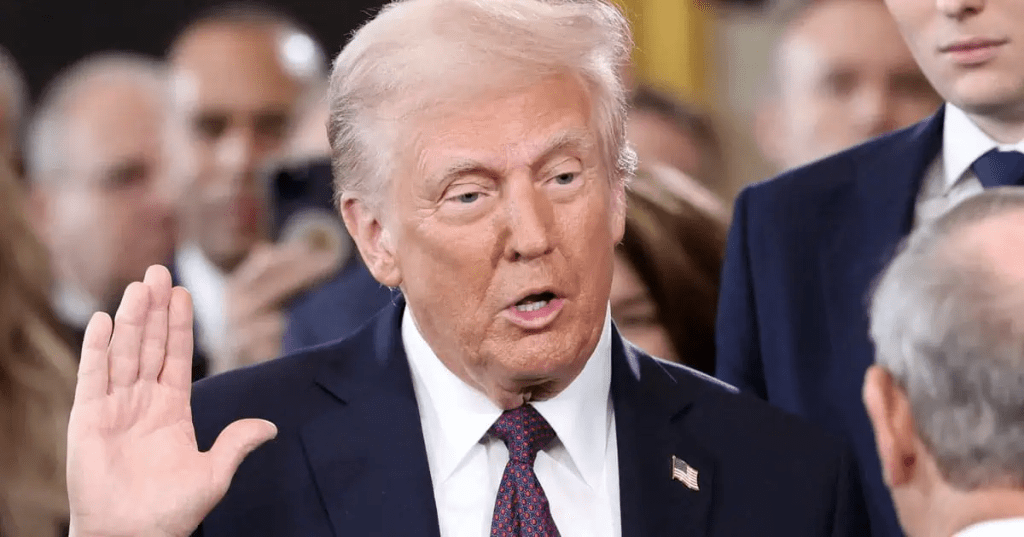
Blogger Comment: The UK is definitely going towards a communist state as free-speech, a balanced view and telling both sides of a story (as there is always two sides to every story my mother used to tell me and before you make up your mind of who is telling the truth) is being eroded and destroyed on the conservative side, but not the far-left that is being exalted to the pre-eminent view status to all others in the United Kingdom…and where as I stated, to overridingly the communist view of any political subject or basically any subject for that matter …period…
.
A veteran British teacher has been referred to the UK government’s counter-terrorism investigations team after showing students video clips of President Donald Trump during a class on U.S. politics.
Critics say the case exposes a growing culture of ideological censorship inside Britain’s education system.
The incident took place at Henley College in Oxfordshire, where the longtime educator, qualified since the mid-1990s, presented students with footage from Trump’s inauguration and campaign to illustrate the outcome of the U.S. election.
Days later, two students complained that the lesson material was “biased.”
Students claimed they were “emotionally disturbed,” and one alleged the videos of Trump caused nightmares.
College officials escalated the matter to the Local Authority Designated Officer (LADO).
LADO prioritized a referral to the government’s counter-terrorism unit, Prevent, and warned that the teacher’s political views “could be perceived as radical.”
Officials warned that the teacher’s actions could potentially amount to hate-related conduct, terrorism, or “radicalisation.”
Speaking to The Telegraph, the teacher described the experience as “completely jarring.
“It’s dystopian, like something from a George Orwell novel,” he explained.
“It was just terrifying; just mind-boggling,” he said.
“We were discussing the US election, Trump had just won, and I showed a couple of videos from the Trump campaign.
“Next thing, I was accused of bias.
“One of the students said they were emotionally disturbed and claimed to have had nightmares.”
Identifying himself as a “mainstream Republican,” he rejected the extremist label outright.
“I am not an extremist,” he said, accusing the college of “complete Left-wing bias,” and adding:
“They don’t tolerate anything about Donald Trump.”
In correspondence cited in the dispute, the college asserted that he had “shown your students videos of Donald Trump, his campaign, propaganda, and other videos which are unrelated to what is being taught.”
The LADO report went further, warning:
“There is concern that this behaviour could cause harm to a child, there could be a criminal offence from the views which could constitute a hate crime, and it’s possible that his promoting of views could be radicalisation.”
The dispute concluded with the teacher resigning and accepting a £2,000 ($2,695) settlement, effectively forced out of his role for presenting political material directly tied to the course subject matter.
Critics Say Safeguarding System Now Targets Dissent
Free speech advocates say the case highlights how safeguarding frameworks are increasingly used to police political opinions, particularly those seen as Right-leaning.
They warn that the incident reflects a broader shift inside schools toward ideological filtering, even as classrooms simultaneously promote aggressively revisionist or activist-driven curricula under “decolonizing” initiatives.
The case also coincides with government-backed programs instructing students to scrutinize and “identify extremist content and misinformation,” programs critics argue are being used to condition children to reject viewpoints that challenge establishment narratives.
Reform UK leader Nigel Farage cautioned that speech boundaries are rapidly narrowing.
Farage warns that the socialist government is making people fear being labeled an “extremist” to “set a narrative for a future generation that is fundamentally undemocratic.”
He is calling globalist Prime Minister Keir Starmer the “biggest threat to free speech” in British history.
The Free Speech Union has likewise warned that safeguarding processes are being applied to “unfashionable opinions,” creating what critics describe as a climate of fear among educators.
For the teacher at the center of the case, the message was unmistakable as political discussion involving Trump, even in a class about American politics, now risks triggering counter-terror scrutiny.
Follow the link for the source… https://slaynews.com/news/uk-teacher-reported-counter-terrorism-investigators-showing-trump-videos-politics-class/
And,
READ MORE – UK Rolls Out Orwellian ‘Toxic Ideas’ Crackdown on Schoolboys
-
Doctors Baffled as Rare Cancer Surges in Young People

Blogger Comment: We all know or should do in recent times what the elephant in the room is that ‘westrern’ governments, health authorities and medical researchers (except a few, but more coming forward these days) never even mention, but where most diseaeses and virus are man-made in the lab and basically released on us if you do your own research …to keep the health and Big Pharma industrial complex going at full steam making all those US$trilions for their shareholders (the Globalists)…period
.
A disturbing new pattern is emerging across the United States, leaving doctors baffled as a once-rare form of deadly cancer is now surging among young Americans.
U.S. cancer data has sent experts scrambling for answers as researchers admit they don’t know what’s driving the alarming spike.
The once-rare appendiceal cancer, which typically appeared in elderly patients, is now showing up in startling numbers among people under 50.
The shift is dramatic.
Recent U.S. research shows that Gen X and Millennials are now three to four times more likely to be diagnosed with appendix cancer than older generations.
Roughly one in three patients is now under 50, a complete reversal of historical trends.
Vanderbilt University epidemiologist and molecular biologist Andreana Holowatyj, who has led multiple national studies on the disease, found in 2020 that malignant appendix cancer diagnoses increased 232% between 2000 and 2016.
Every generation saw increases, but the spike among younger adults is the most pronounced.
The real danger is that appendix cancer is notoriously stealthy.
Symptoms are vague and include mild abdominal pain, bloating, and pelvic discomfort.
Doctors note that these are issues that most people chalk up to indigestion or other common gastrointestinal problems.
As a result, doctors often discover the cancer only after a patient undergoes emergency surgery for presumed appendicitis.
However, by then, early intervention is off the table.
There are no screening guidelines for appendiceal cancer.
Awareness is virtually nonexistent.
And to make matters worse, the disease behaves differently from colorectal cancer and doesn’t respond well to standard chemotherapy.
Despite the alarming rise, experts still don’t know why it’s happening.
Doctors openly acknowledge they’re baffled as researchers scramble to identify what’s driving the trend.
Holowatyj and others have floated a list of possible culprits, but no definitive answers.
Among the potential contributors:
• Lifestyle shifts: ultra-processed foods, alcohol, sleep disruption, declining physical activity
• Environmental exposures: plastics, chemicals, pollutants, degraded water quality
• Biological changes: inherited genetic variants, gut microbiome disruption
The unexplained surge fits a broader and worrying pattern:
Similar increases are being documented in other gastrointestinal cancers, including colorectal, bile duct, and pancreatic, especially among younger adults.
Researchers warn that this growing crisis cannot be ignored.
They are calling for urgent, targeted studies to determine who is most at risk and what environmental or lifestyle factors might be contributing.
Early detection could dramatically change survival outcomes, but right now, the tools simply don’t exist.
Until more answers emerge, doctors are urging younger adults to take persistent digestive symptoms seriously.
Even mild or recurring abdominal issues should be evaluated rather than dismissed.
The spike is real, the trend is accelerating, and for now, the cause remains a mystery.
Follow the link for the source… https://slaynews.com/news/doctors-baffled-rare-cancer-surges-young-people/
And,
READ MORE – Experts Sound Alarm Over Cancer Risk from Lab-Grown ‘Meat’

-
Subscribe
Subscribed
Already have a WordPress.com account? Log in now.
 World Freedom